
Did you know a garage makeover can boost your home’s value by up to 80% of the cost? Turning unused space into living areas is a smart investment for homeowners in Southern California.
When you start a garage makeover, the plumbing can surprise you. What looks simple can turn complex with new water lines, drainage, and venting needed.
At Local Plumbers 4 U, we’ve helped many in the Inland Empire with their garage makeovers. Our experience in Riverside County, San Bernardino, and Corona shows that planning your water system is essential before you start building.
Adding a bathroom or kitchenette makes your space more useful but needs careful thought. Checking your current setup helps figure out if you need special equipment like ejector pumps.
The cost of water lines and drainage is a big part of your budget. Knowing these costs early helps avoid surprises and keeps your project on track and within budget.
Key Takeaways
- A professional plumbing assessment should be your first step before beginning any conversion work
- Water supply and drainage installation must happen before finishing walls and floors
- Local building codes in Inland Empire areas have specific requirements for adding bathrooms
- Proper pipe insulation is key to prevent freezing and bursting in converted spaces
- Your home’s existing water pressure may need evaluation to support additional fixtures
- Drainage systems require proper venting to prevent odors and ensure efficient operation
Essential Plumbing Considerations for Garage Conversions
When planning a garage conversion, think about plumbing early. It can save you time, money, and stress. You’ll need to plan carefully, whether you’re making a guest suite, office, or entertainment area.
The plumbing needs vary based on the space’s use. A workshop might need just a utility sink. But a full apartment conversion requires complete bathroom and kitchen plumbing. Before deciding, consider all aspects of garage remodeling, including plumbing.
Understand Your Current Plumbing System
First, evaluate your garage’s plumbing. Most garages have little or no plumbing. You’ll need to plan carefully to add what’s needed.
Start by finding the nearest water and drain lines. A professional can assess your plumbing. They’ll find connection points, check water pressure, and spot issues. This helps set a budget and timeline for plumbing.
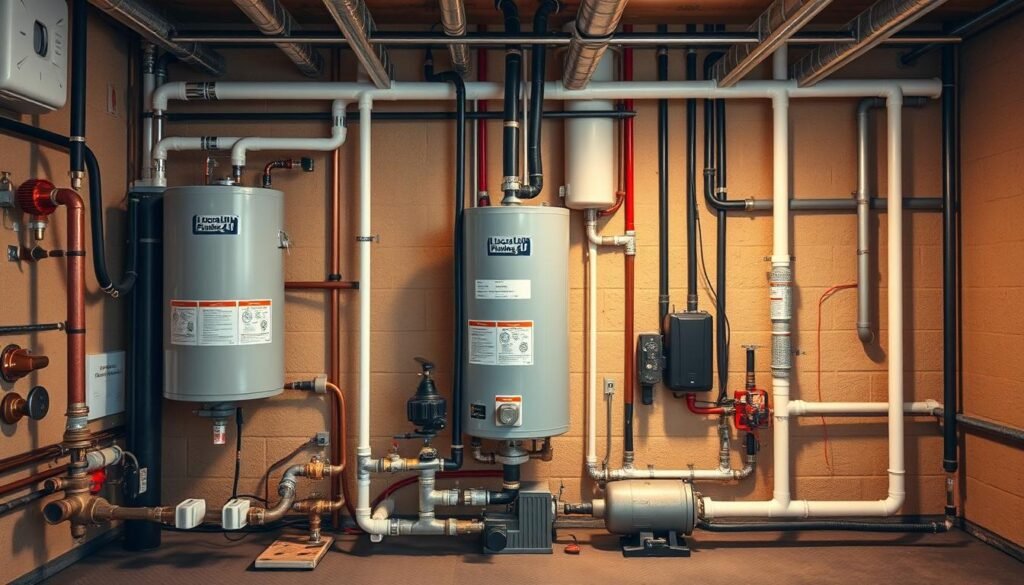
The distance to plumbing lines affects project complexity and cost. If your garage is far, you might need to run new lines. This could mean higher costs for labor and materials. You might also need a sewage ejector pump if gravity drainage isn’t possible.
Water pressure is also key. Adding fixtures can lower your home’s pressure. A plumber can check if your system can handle the extra demand or if upgrades are needed.
Identify New Plumbing Needs
After understanding your current plumbing, decide what new features you need. Will you add a bathroom, kitchenette, or just a utility sink?
Each fixture has specific needs for water supply and drainage. Bathrooms need hot and cold lines, ventilation, and proper drainage. Kitchenettes require similar planning, with extra considerations for appliances like dishwashers.
Choose water-efficient fixtures to save on bills and be eco-friendly. Place fixtures near existing lines to save on installation costs.
Adding fixtures makes your project more complex. Be honest about what you need versus what you’d like. A detailed floor plan helps your plumber estimate costs and ensure fixtures are placed correctly.
Local Building Codes and Permits
Understanding local building codes and getting permits is vital, mainly in the Inland Empire, Riverside County, San Bernardino, and Corona areas. Each place has its own plumbing rules for converted spaces.
Most places need permits for plumbing changes, like turning a garage into living space. These ensure work meets safety and building codes. In Riverside County and San Bernardino, compliance includes venting, drainage slope, water pressure, backflow prevention, and fixture clearances.
- Proper venting of drain lines
- Minimum drainage slope requirements
- Water pressure standards
- Backflow prevention devices
- Fixture clearances and accessibility
Without proper permits, you face fines, selling issues, and safety risks. Unpermitted work might not be covered by insurance if problems occur.
The permitting process involves submitting plans, paying fees, and scheduling inspections. It may seem hard, but it’s to protect you and ensure safety.
Working with a licensed plumber familiar with local codes helps. They prepare documents, ensure compliance, and coordinate with inspectors. This keeps your project on track.
Common Plumbing Adjustments in Garage Conversions
Turning your garage into a living space needs careful plumbing work. This ensures it works well and meets building rules. Garages often lack plumbing, so you’ll need to make key changes.
Relocating Water Lines
Adding water lines to your garage is a big task. Most garages don’t have water connections. You’ll tap into your home’s main water system.
Connecting to nearby water lines in your home is best. This could be in a bathroom, kitchen, or laundry room. The distance affects the project’s complexity and cost.
When moving water lines, several things matter:
- Pipe material must match your system
- Water pressure is key for new fixtures
- Insulation prevents freezing
- Easy access for future repairs
- Following local plumbing codes
For hot water, you can extend lines from your heater or get a point-of-use heater. The heater gives hot water right away and saves energy.
If you’re turning your garage into a bedroom, planning water lines is critical. This ensures enough water pressure and temperature for comfort.
Installing Drainage Systems
Drainage systems are a big challenge in garage conversions. They need gravity and venting to work right.
Garage floors often sit below the sewer line. This means you might need a sewage ejector pump. These pumps move waste water up to reach your sewer system.
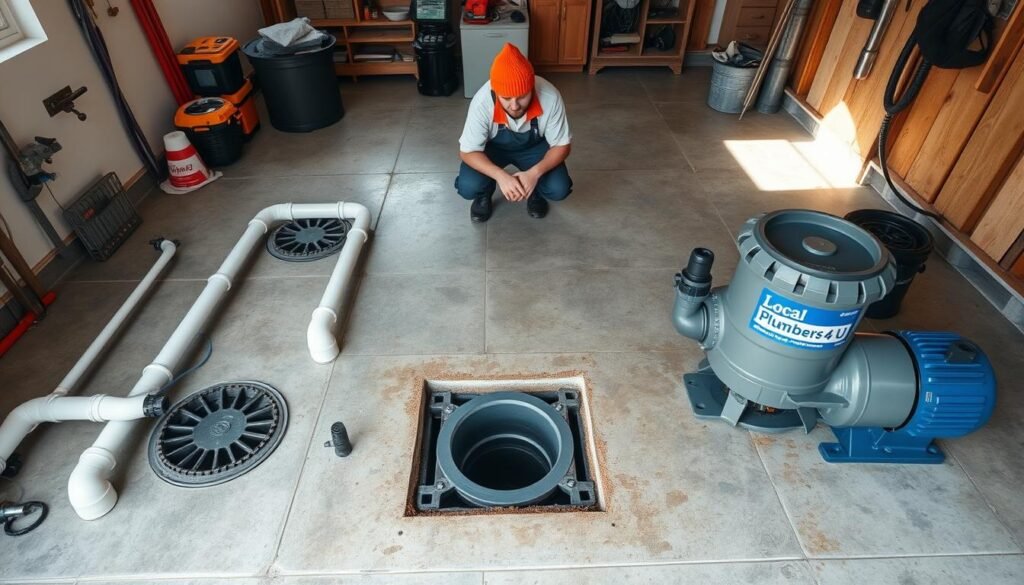
The Saniaccess 2 is a good choice for garage conversions. It has a strong pump and macerator. It breaks down waste into a slurry that can be pumped up to 15 feet or 150 feet horizontally.
Vent piping is also key for drainage systems. Vents let air into the pipes, helping waste water flow and preventing bad smells. Without vents, you might get gurgling sounds, slow drains, or sewer gas odors.
Adding Plumbing Fixtures
Choosing the right plumbing fixtures is vital for a functional and nice space. In the Inland Empire, Riverside County, San Bernardino, and Corona areas, there are important things to consider.
Water-efficient fixtures save resources and lower bills. Look for WaterSense-labeled products, which use 20% less water than standard ones.
Space is often a concern in garage conversions. Compact sinks, wall-mounted toilets, and shower stalls save space while keeping everything functional.
Here are some fixture options for different garage conversion needs:
| Conversion Type | Recommended Fixtures | Space Requirements | Installation Complexity | Average Cost Range |
|---|---|---|---|---|
| Bathroom Addition | Compact toilet, corner shower, wall-mounted sink | 25-35 sq. ft. minimum | High (requires water, drain, vent) | $5,000-$15,000 |
| Kitchenette | Bar sink, instant hot water dispenser | 15-25 sq. ft. minimum | Medium (water and drain only) | $2,500-$8,000 |
| Laundry Room | Utility sink, washer hookups | 20-30 sq. ft. minimum | Medium (specialized drain needed) | $1,800-$6,000 |
| Studio Apartment | All-in-one bathroom unit, compact kitchen sink | 40-60 sq. ft. for plumbing areas | Very High (complete system) | $8,000-$20,000 |
When picking bathroom fixtures, think about how you’ll use the space. For a full bathroom, you need a toilet, sink, and shower or tub. For a half bath, just a toilet and sink are enough. The quality and style of fixtures greatly affect your space’s look and function.
All plumbing work must follow local building codes. These rules cover fixture clearances, water efficiency, and accessibility. A licensed plumber familiar with these codes can help your conversion pass inspection first time.
How Local Plumbers 4 U Can Help You
Need help with garage conversion plumbing? Local Plumbers 4 U’s team is here for you. We’re experts in turning garages into living spaces. Our licensed pros serve the Inland Empire, Riverside County, San Bernardino, and Corona areas.
We know how important plumbing is for your project. That’s why we offer solutions tailored to your needs.
Expert Consultations
Every project starts with a consultation at Local Plumbers 4 U. Our plumbers will check your garage and plumbing. This helps us find the best spots for water and sewer lines.
We’ll talk about your vision and what plumbing you need. Whether it’s a half-bathroom or a full kitchen, we’ll guide you.
We also help with local building codes and permits. Our team keeps up with Inland Empire plumbing codes. This ensures your project meets all requirements.
After the consultation, you’ll get a detailed estimate. It will include all work, costs, and timelines. This way, you can make informed decisions about your project.
Comprehensive Plumbing Services
Local Plumbers 4 U offers a wide range of plumbing services for garage conversions. We handle everything from planning to installation. This ensures your plumbing system works perfectly.
Mr. Cariola saved money with our above-floor plumbing solutions. His bathroom renovation took just three days. We always recommend a licensed plumber for the best results.
Our services include:
- Water supply line installation and connection to existing systems
- Drain installation and sewage solutions, including above-floor options
- Bathroom plumbing for sinks, toilets, showers, and bathtubs
- Kitchen plumbing for sinks, dishwashers, and other appliances
- Laundry room connections for washers and utility sinks
- Water heater installation and connection
- Permit acquisition and code compliance management
For many, garage to ADU conversion projects need special plumbing. Our team finds cost-effective solutions that meet your needs.
| Plumbing Solution | Average Cost | Installation Time | Best For | Limitations |
|---|---|---|---|---|
| Traditional Below-Floor Plumbing | $5,000-$8,000 | 5-7 days | Full bathrooms, kitchens | Requires concrete cutting, more invasive |
| Above-Floor Systems | $1,500-$3,000 | 2-3 days | Half baths, simple installations | May have visible components |
| Hybrid Solutions | $3,000-$5,000 | 3-5 days | Versatile applications | Requires careful planning |
| Wet Wall Installation | $2,500-$4,500 | 4-6 days | Adjacent to existing plumbing | Limited placement options |
Contact Us for Your Plumbing Needs
Ready to turn your garage into a living space? Local Plumbers 4 U is here to help. We serve the Inland Empire region.
It’s easy to contact us. Call 909-378-9322 to schedule a consultation. Our staff will arrange a visit at your convenience.
For more info or to request a quote online, visit our website at https://localplumbersincorona.com/. Our site has details on our services, customer testimonials, and project planning resources.
Don’t let plumbing issues slow down your garage conversion. Trust Local Plumbers 4 U for professional solutions. Contact us today to start your project!
Frequently Asked Questions
Got questions about your garage conversion plumbing project? We’ve got answers for homeowners and business owners in the Inland Empire area.
What plumbing permits do I need for a garage conversion?
In Riverside and San Bernardino counties, you need a general building permit and specific plumbing permits. These cover water supply lines and drainage systems. Most cities require detailed plumbing plans.
Permit fees vary from $300-$1,000, based on your project’s size. Local Plumbers 4 U can help you with the permit process to meet plumbing code standards.
How do I know if my garage can support new plumbing?
To check if your garage can handle plumbing, look at its distance to water and sewer lines. Also, check the concrete slab and the structure’s strength. Even with concrete slabs, we can install plumbing above or below.
Our team will assess your garage to find the best plumbing solution. This includes drain installation and water supply connections.
What are the typical costs for plumbing in a garage conversion?
Installing basic plumbing fixtures like a sink or toilet costs $1,500-$3,000. A full bathroom with multiple fixtures can cost $5,000-$10,000.
For alternative drainage, like macerating systems, expect to pay $2,000-$3,500. This can save money compared to traditional drains. The type of fixtures you choose also affects the cost.
How can I contact Local Plumbers 4 U?
It’s easy to reach us! Call 909-378-9322 for help with your garage conversion plumbing. Or visit our website at https://localplumbersincorona.com/ to schedule a consultation. We serve the Inland Empire, including Riverside County, San Bernardino, and Corona.
FAQ
What plumbing permits do I need for a garage conversion?
How do I know if my garage can support new plumbing?
What are the typical costs for plumbing in a garage conversion?
FAQ
What plumbing permits do I need for a garage conversion?
For garage conversions in the Inland Empire, you’ll need several plumbing permits. You’ll get a general building permit and specific plumbing permits for new water lines, drainage, and fixtures. In Riverside and San Bernardino counties, detailed plumbing plans are required.
These plans must show fixture locations, pipe routes, and venting. The process includes submitting plans, paying fees, and scheduling inspections.
How do I know if my garage can support new plumbing?
Check if your garage is close to water and sewer lines. Look at the concrete slab’s condition and garage wall strength. Even tough garages can handle plumbing with the right solutions.
Professional plumbers can assess your garage’s plumbing needs. They know the Inland Empire’s specific requirements.
What are the typical costs for plumbing in a garage conversion?
Plumbing costs vary in the Inland Empire. Water line extensions cost 0-
FAQ
What plumbing permits do I need for a garage conversion?
For garage conversions in the Inland Empire, you’ll need several plumbing permits. You’ll get a general building permit and specific plumbing permits for new water lines, drainage, and fixtures. In Riverside and San Bernardino counties, detailed plumbing plans are required.
These plans must show fixture locations, pipe routes, and venting. The process includes submitting plans, paying fees, and scheduling inspections.
How do I know if my garage can support new plumbing?
Check if your garage is close to water and sewer lines. Look at the concrete slab’s condition and garage wall strength. Even tough garages can handle plumbing with the right solutions.
Professional plumbers can assess your garage’s plumbing needs. They know the Inland Empire’s specific requirements.
What are the typical costs for plumbing in a garage conversion?
Plumbing costs vary in the Inland Empire. Water line extensions cost $500-$1,500. Drainage systems cost $1,500-$4,000. Above-floor systems are $1,000-$2,500.
Fixture prices range from $150 to $800. Permit fees are $300-$1,000. Labor costs are $75-$150 per hour. A garage bathroom can cost $3,000-$10,000 for plumbing alone.
How can I contact Local Plumbers 4 U?
Contact Local Plumbers 4 U easily. Call 909-378-9322 or visit https://localplumbersincorona.com/ to schedule online. You can also email us at the website address.
We serve the Inland Empire, including Corona. We offer free consultations and estimates for garage plumbing projects.
What are the options for installing drainage in a garage with a concrete slab?
You have two drainage options for concrete slabs. Traditional below-floor drainage is more invasive but effective. It involves cutting the slab and installing pipes.
Above-floor systems like macerating toilets are less invasive. They use small pipes routed along walls and through joists. They’re more cost-effective and less disruptive.
Do I need to add vent piping for new plumbing fixtures in my garage conversion?
Yes, vent piping is essential for new fixtures. It prevents siphoning and ensures proper drainage. Each fixture needs a vent stack through the roof.
Local codes specify vent pipe requirements. Professional installation is key to prevent sewer gases and ensure proper drainage.
What water heater options should I consider for my garage conversion?
You have several water heater options. Extending hot water lines from your existing heater may cause wait times and pressure issues. Installing a tankless water heater provides immediate hot water and is energy-efficient.
For multiple fixtures, a small tank water heater or heat pump water heater might be suitable. The best option depends on your needs, budget, and space use.
,500. Drainage systems cost
FAQ
What plumbing permits do I need for a garage conversion?
For garage conversions in the Inland Empire, you’ll need several plumbing permits. You’ll get a general building permit and specific plumbing permits for new water lines, drainage, and fixtures. In Riverside and San Bernardino counties, detailed plumbing plans are required.
These plans must show fixture locations, pipe routes, and venting. The process includes submitting plans, paying fees, and scheduling inspections.
How do I know if my garage can support new plumbing?
Check if your garage is close to water and sewer lines. Look at the concrete slab’s condition and garage wall strength. Even tough garages can handle plumbing with the right solutions.
Professional plumbers can assess your garage’s plumbing needs. They know the Inland Empire’s specific requirements.
What are the typical costs for plumbing in a garage conversion?
Plumbing costs vary in the Inland Empire. Water line extensions cost $500-$1,500. Drainage systems cost $1,500-$4,000. Above-floor systems are $1,000-$2,500.
Fixture prices range from $150 to $800. Permit fees are $300-$1,000. Labor costs are $75-$150 per hour. A garage bathroom can cost $3,000-$10,000 for plumbing alone.
How can I contact Local Plumbers 4 U?
Contact Local Plumbers 4 U easily. Call 909-378-9322 or visit https://localplumbersincorona.com/ to schedule online. You can also email us at the website address.
We serve the Inland Empire, including Corona. We offer free consultations and estimates for garage plumbing projects.
What are the options for installing drainage in a garage with a concrete slab?
You have two drainage options for concrete slabs. Traditional below-floor drainage is more invasive but effective. It involves cutting the slab and installing pipes.
Above-floor systems like macerating toilets are less invasive. They use small pipes routed along walls and through joists. They’re more cost-effective and less disruptive.
Do I need to add vent piping for new plumbing fixtures in my garage conversion?
Yes, vent piping is essential for new fixtures. It prevents siphoning and ensures proper drainage. Each fixture needs a vent stack through the roof.
Local codes specify vent pipe requirements. Professional installation is key to prevent sewer gases and ensure proper drainage.
What water heater options should I consider for my garage conversion?
You have several water heater options. Extending hot water lines from your existing heater may cause wait times and pressure issues. Installing a tankless water heater provides immediate hot water and is energy-efficient.
For multiple fixtures, a small tank water heater or heat pump water heater might be suitable. The best option depends on your needs, budget, and space use.
,500-,000. Above-floor systems are
FAQ
What plumbing permits do I need for a garage conversion?
For garage conversions in the Inland Empire, you’ll need several plumbing permits. You’ll get a general building permit and specific plumbing permits for new water lines, drainage, and fixtures. In Riverside and San Bernardino counties, detailed plumbing plans are required.
These plans must show fixture locations, pipe routes, and venting. The process includes submitting plans, paying fees, and scheduling inspections.
How do I know if my garage can support new plumbing?
Check if your garage is close to water and sewer lines. Look at the concrete slab’s condition and garage wall strength. Even tough garages can handle plumbing with the right solutions.
Professional plumbers can assess your garage’s plumbing needs. They know the Inland Empire’s specific requirements.
What are the typical costs for plumbing in a garage conversion?
Plumbing costs vary in the Inland Empire. Water line extensions cost $500-$1,500. Drainage systems cost $1,500-$4,000. Above-floor systems are $1,000-$2,500.
Fixture prices range from $150 to $800. Permit fees are $300-$1,000. Labor costs are $75-$150 per hour. A garage bathroom can cost $3,000-$10,000 for plumbing alone.
How can I contact Local Plumbers 4 U?
Contact Local Plumbers 4 U easily. Call 909-378-9322 or visit https://localplumbersincorona.com/ to schedule online. You can also email us at the website address.
We serve the Inland Empire, including Corona. We offer free consultations and estimates for garage plumbing projects.
What are the options for installing drainage in a garage with a concrete slab?
You have two drainage options for concrete slabs. Traditional below-floor drainage is more invasive but effective. It involves cutting the slab and installing pipes.
Above-floor systems like macerating toilets are less invasive. They use small pipes routed along walls and through joists. They’re more cost-effective and less disruptive.
Do I need to add vent piping for new plumbing fixtures in my garage conversion?
Yes, vent piping is essential for new fixtures. It prevents siphoning and ensures proper drainage. Each fixture needs a vent stack through the roof.
Local codes specify vent pipe requirements. Professional installation is key to prevent sewer gases and ensure proper drainage.
What water heater options should I consider for my garage conversion?
You have several water heater options. Extending hot water lines from your existing heater may cause wait times and pressure issues. Installing a tankless water heater provides immediate hot water and is energy-efficient.
For multiple fixtures, a small tank water heater or heat pump water heater might be suitable. The best option depends on your needs, budget, and space use.
,000-,500.
Fixture prices range from 0 to 0. Permit fees are 0-
FAQ
What plumbing permits do I need for a garage conversion?
For garage conversions in the Inland Empire, you’ll need several plumbing permits. You’ll get a general building permit and specific plumbing permits for new water lines, drainage, and fixtures. In Riverside and San Bernardino counties, detailed plumbing plans are required.
These plans must show fixture locations, pipe routes, and venting. The process includes submitting plans, paying fees, and scheduling inspections.
How do I know if my garage can support new plumbing?
Check if your garage is close to water and sewer lines. Look at the concrete slab’s condition and garage wall strength. Even tough garages can handle plumbing with the right solutions.
Professional plumbers can assess your garage’s plumbing needs. They know the Inland Empire’s specific requirements.
What are the typical costs for plumbing in a garage conversion?
Plumbing costs vary in the Inland Empire. Water line extensions cost $500-$1,500. Drainage systems cost $1,500-$4,000. Above-floor systems are $1,000-$2,500.
Fixture prices range from $150 to $800. Permit fees are $300-$1,000. Labor costs are $75-$150 per hour. A garage bathroom can cost $3,000-$10,000 for plumbing alone.
How can I contact Local Plumbers 4 U?
Contact Local Plumbers 4 U easily. Call 909-378-9322 or visit https://localplumbersincorona.com/ to schedule online. You can also email us at the website address.
We serve the Inland Empire, including Corona. We offer free consultations and estimates for garage plumbing projects.
What are the options for installing drainage in a garage with a concrete slab?
You have two drainage options for concrete slabs. Traditional below-floor drainage is more invasive but effective. It involves cutting the slab and installing pipes.
Above-floor systems like macerating toilets are less invasive. They use small pipes routed along walls and through joists. They’re more cost-effective and less disruptive.
Do I need to add vent piping for new plumbing fixtures in my garage conversion?
Yes, vent piping is essential for new fixtures. It prevents siphoning and ensures proper drainage. Each fixture needs a vent stack through the roof.
Local codes specify vent pipe requirements. Professional installation is key to prevent sewer gases and ensure proper drainage.
What water heater options should I consider for my garage conversion?
You have several water heater options. Extending hot water lines from your existing heater may cause wait times and pressure issues. Installing a tankless water heater provides immediate hot water and is energy-efficient.
For multiple fixtures, a small tank water heater or heat pump water heater might be suitable. The best option depends on your needs, budget, and space use.
,000. Labor costs are -0 per hour. A garage bathroom can cost ,000-,000 for plumbing alone.
How can I contact Local Plumbers 4 U?
Contact Local Plumbers 4 U easily. Call 909-378-9322 or visit https://localplumbersincorona.com/ to schedule online. You can also email us at the website address.
We serve the Inland Empire, including Corona. We offer free consultations and estimates for garage plumbing projects.
What are the options for installing drainage in a garage with a concrete slab?
You have two drainage options for concrete slabs. Traditional below-floor drainage is more invasive but effective. It involves cutting the slab and installing pipes.
Above-floor systems like macerating toilets are less invasive. They use small pipes routed along walls and through joists. They’re more cost-effective and less disruptive.
Do I need to add vent piping for new plumbing fixtures in my garage conversion?
Yes, vent piping is essential for new fixtures. It prevents siphoning and ensures proper drainage. Each fixture needs a vent stack through the roof.
Local codes specify vent pipe requirements. Professional installation is key to prevent sewer gases and ensure proper drainage.
What water heater options should I consider for my garage conversion?
You have several water heater options. Extending hot water lines from your existing heater may cause wait times and pressure issues. Installing a tankless water heater provides immediate hot water and is energy-efficient.
For multiple fixtures, a small tank water heater or heat pump water heater might be suitable. The best option depends on your needs, budget, and space use.
FAQ
What plumbing permits do I need for a garage conversion?
For garage conversions in the Inland Empire, you’ll need several plumbing permits. You’ll get a general building permit and specific plumbing permits for new water lines, drainage, and fixtures. In Riverside and San Bernardino counties, detailed plumbing plans are required.
These plans must show fixture locations, pipe routes, and venting. The process includes submitting plans, paying fees, and scheduling inspections.
How do I know if my garage can support new plumbing?
Check if your garage is close to water and sewer lines. Look at the concrete slab’s condition and garage wall strength. Even tough garages can handle plumbing with the right solutions.
Professional plumbers can assess your garage’s plumbing needs. They know the Inland Empire’s specific requirements.
What are the typical costs for plumbing in a garage conversion?
Plumbing costs vary in the Inland Empire. Water line extensions cost 0-
FAQ
What plumbing permits do I need for a garage conversion?
For garage conversions in the Inland Empire, you’ll need several plumbing permits. You’ll get a general building permit and specific plumbing permits for new water lines, drainage, and fixtures. In Riverside and San Bernardino counties, detailed plumbing plans are required.
These plans must show fixture locations, pipe routes, and venting. The process includes submitting plans, paying fees, and scheduling inspections.
How do I know if my garage can support new plumbing?
Check if your garage is close to water and sewer lines. Look at the concrete slab’s condition and garage wall strength. Even tough garages can handle plumbing with the right solutions.
Professional plumbers can assess your garage’s plumbing needs. They know the Inland Empire’s specific requirements.
What are the typical costs for plumbing in a garage conversion?
Plumbing costs vary in the Inland Empire. Water line extensions cost $500-$1,500. Drainage systems cost $1,500-$4,000. Above-floor systems are $1,000-$2,500.
Fixture prices range from $150 to $800. Permit fees are $300-$1,000. Labor costs are $75-$150 per hour. A garage bathroom can cost $3,000-$10,000 for plumbing alone.
How can I contact Local Plumbers 4 U?
Contact Local Plumbers 4 U easily. Call 909-378-9322 or visit https://localplumbersincorona.com/ to schedule online. You can also email us at the website address.
We serve the Inland Empire, including Corona. We offer free consultations and estimates for garage plumbing projects.
What are the options for installing drainage in a garage with a concrete slab?
You have two drainage options for concrete slabs. Traditional below-floor drainage is more invasive but effective. It involves cutting the slab and installing pipes.
Above-floor systems like macerating toilets are less invasive. They use small pipes routed along walls and through joists. They’re more cost-effective and less disruptive.
Do I need to add vent piping for new plumbing fixtures in my garage conversion?
Yes, vent piping is essential for new fixtures. It prevents siphoning and ensures proper drainage. Each fixture needs a vent stack through the roof.
Local codes specify vent pipe requirements. Professional installation is key to prevent sewer gases and ensure proper drainage.
What water heater options should I consider for my garage conversion?
You have several water heater options. Extending hot water lines from your existing heater may cause wait times and pressure issues. Installing a tankless water heater provides immediate hot water and is energy-efficient.
For multiple fixtures, a small tank water heater or heat pump water heater might be suitable. The best option depends on your needs, budget, and space use.
,500. Drainage systems cost
FAQ
What plumbing permits do I need for a garage conversion?
For garage conversions in the Inland Empire, you’ll need several plumbing permits. You’ll get a general building permit and specific plumbing permits for new water lines, drainage, and fixtures. In Riverside and San Bernardino counties, detailed plumbing plans are required.
These plans must show fixture locations, pipe routes, and venting. The process includes submitting plans, paying fees, and scheduling inspections.
How do I know if my garage can support new plumbing?
Check if your garage is close to water and sewer lines. Look at the concrete slab’s condition and garage wall strength. Even tough garages can handle plumbing with the right solutions.
Professional plumbers can assess your garage’s plumbing needs. They know the Inland Empire’s specific requirements.
What are the typical costs for plumbing in a garage conversion?
Plumbing costs vary in the Inland Empire. Water line extensions cost $500-$1,500. Drainage systems cost $1,500-$4,000. Above-floor systems are $1,000-$2,500.
Fixture prices range from $150 to $800. Permit fees are $300-$1,000. Labor costs are $75-$150 per hour. A garage bathroom can cost $3,000-$10,000 for plumbing alone.
How can I contact Local Plumbers 4 U?
Contact Local Plumbers 4 U easily. Call 909-378-9322 or visit https://localplumbersincorona.com/ to schedule online. You can also email us at the website address.
We serve the Inland Empire, including Corona. We offer free consultations and estimates for garage plumbing projects.
What are the options for installing drainage in a garage with a concrete slab?
You have two drainage options for concrete slabs. Traditional below-floor drainage is more invasive but effective. It involves cutting the slab and installing pipes.
Above-floor systems like macerating toilets are less invasive. They use small pipes routed along walls and through joists. They’re more cost-effective and less disruptive.
Do I need to add vent piping for new plumbing fixtures in my garage conversion?
Yes, vent piping is essential for new fixtures. It prevents siphoning and ensures proper drainage. Each fixture needs a vent stack through the roof.
Local codes specify vent pipe requirements. Professional installation is key to prevent sewer gases and ensure proper drainage.
What water heater options should I consider for my garage conversion?
You have several water heater options. Extending hot water lines from your existing heater may cause wait times and pressure issues. Installing a tankless water heater provides immediate hot water and is energy-efficient.
For multiple fixtures, a small tank water heater or heat pump water heater might be suitable. The best option depends on your needs, budget, and space use.
,500-,000. Above-floor systems are
FAQ
What plumbing permits do I need for a garage conversion?
For garage conversions in the Inland Empire, you’ll need several plumbing permits. You’ll get a general building permit and specific plumbing permits for new water lines, drainage, and fixtures. In Riverside and San Bernardino counties, detailed plumbing plans are required.
These plans must show fixture locations, pipe routes, and venting. The process includes submitting plans, paying fees, and scheduling inspections.
How do I know if my garage can support new plumbing?
Check if your garage is close to water and sewer lines. Look at the concrete slab’s condition and garage wall strength. Even tough garages can handle plumbing with the right solutions.
Professional plumbers can assess your garage’s plumbing needs. They know the Inland Empire’s specific requirements.
What are the typical costs for plumbing in a garage conversion?
Plumbing costs vary in the Inland Empire. Water line extensions cost $500-$1,500. Drainage systems cost $1,500-$4,000. Above-floor systems are $1,000-$2,500.
Fixture prices range from $150 to $800. Permit fees are $300-$1,000. Labor costs are $75-$150 per hour. A garage bathroom can cost $3,000-$10,000 for plumbing alone.
How can I contact Local Plumbers 4 U?
Contact Local Plumbers 4 U easily. Call 909-378-9322 or visit https://localplumbersincorona.com/ to schedule online. You can also email us at the website address.
We serve the Inland Empire, including Corona. We offer free consultations and estimates for garage plumbing projects.
What are the options for installing drainage in a garage with a concrete slab?
You have two drainage options for concrete slabs. Traditional below-floor drainage is more invasive but effective. It involves cutting the slab and installing pipes.
Above-floor systems like macerating toilets are less invasive. They use small pipes routed along walls and through joists. They’re more cost-effective and less disruptive.
Do I need to add vent piping for new plumbing fixtures in my garage conversion?
Yes, vent piping is essential for new fixtures. It prevents siphoning and ensures proper drainage. Each fixture needs a vent stack through the roof.
Local codes specify vent pipe requirements. Professional installation is key to prevent sewer gases and ensure proper drainage.
What water heater options should I consider for my garage conversion?
You have several water heater options. Extending hot water lines from your existing heater may cause wait times and pressure issues. Installing a tankless water heater provides immediate hot water and is energy-efficient.
For multiple fixtures, a small tank water heater or heat pump water heater might be suitable. The best option depends on your needs, budget, and space use.
,000-,500.
Fixture prices range from 0 to 0. Permit fees are 0-
FAQ
What plumbing permits do I need for a garage conversion?
For garage conversions in the Inland Empire, you’ll need several plumbing permits. You’ll get a general building permit and specific plumbing permits for new water lines, drainage, and fixtures. In Riverside and San Bernardino counties, detailed plumbing plans are required.
These plans must show fixture locations, pipe routes, and venting. The process includes submitting plans, paying fees, and scheduling inspections.
How do I know if my garage can support new plumbing?
Check if your garage is close to water and sewer lines. Look at the concrete slab’s condition and garage wall strength. Even tough garages can handle plumbing with the right solutions.
Professional plumbers can assess your garage’s plumbing needs. They know the Inland Empire’s specific requirements.
What are the typical costs for plumbing in a garage conversion?
Plumbing costs vary in the Inland Empire. Water line extensions cost $500-$1,500. Drainage systems cost $1,500-$4,000. Above-floor systems are $1,000-$2,500.
Fixture prices range from $150 to $800. Permit fees are $300-$1,000. Labor costs are $75-$150 per hour. A garage bathroom can cost $3,000-$10,000 for plumbing alone.
How can I contact Local Plumbers 4 U?
Contact Local Plumbers 4 U easily. Call 909-378-9322 or visit https://localplumbersincorona.com/ to schedule online. You can also email us at the website address.
We serve the Inland Empire, including Corona. We offer free consultations and estimates for garage plumbing projects.
What are the options for installing drainage in a garage with a concrete slab?
You have two drainage options for concrete slabs. Traditional below-floor drainage is more invasive but effective. It involves cutting the slab and installing pipes.
Above-floor systems like macerating toilets are less invasive. They use small pipes routed along walls and through joists. They’re more cost-effective and less disruptive.
Do I need to add vent piping for new plumbing fixtures in my garage conversion?
Yes, vent piping is essential for new fixtures. It prevents siphoning and ensures proper drainage. Each fixture needs a vent stack through the roof.
Local codes specify vent pipe requirements. Professional installation is key to prevent sewer gases and ensure proper drainage.
What water heater options should I consider for my garage conversion?
You have several water heater options. Extending hot water lines from your existing heater may cause wait times and pressure issues. Installing a tankless water heater provides immediate hot water and is energy-efficient.
For multiple fixtures, a small tank water heater or heat pump water heater might be suitable. The best option depends on your needs, budget, and space use.
,000. Labor costs are -0 per hour. A garage bathroom can cost ,000-,000 for plumbing alone.
How can I contact Local Plumbers 4 U?
Contact Local Plumbers 4 U easily. Call 909-378-9322 or visit https://localplumbersincorona.com/ to schedule online. You can also email us at the website address.
We serve the Inland Empire, including Corona. We offer free consultations and estimates for garage plumbing projects.
What are the options for installing drainage in a garage with a concrete slab?
You have two drainage options for concrete slabs. Traditional below-floor drainage is more invasive but effective. It involves cutting the slab and installing pipes.
Above-floor systems like macerating toilets are less invasive. They use small pipes routed along walls and through joists. They’re more cost-effective and less disruptive.
Do I need to add vent piping for new plumbing fixtures in my garage conversion?
Yes, vent piping is essential for new fixtures. It prevents siphoning and ensures proper drainage. Each fixture needs a vent stack through the roof.
Local codes specify vent pipe requirements. Professional installation is key to prevent sewer gases and ensure proper drainage.
What water heater options should I consider for my garage conversion?
You have several water heater options. Extending hot water lines from your existing heater may cause wait times and pressure issues. Installing a tankless water heater provides immediate hot water and is energy-efficient.
For multiple fixtures, a small tank water heater or heat pump water heater might be suitable. The best option depends on your needs, budget, and space use.
FAQ
What plumbing permits do I need for a garage conversion?
For garage conversions in the Inland Empire, you’ll need several plumbing permits. You’ll get a general building permit and specific plumbing permits for new water lines, drainage, and fixtures. In Riverside and San Bernardino counties, detailed plumbing plans are required.
These plans must show fixture locations, pipe routes, and venting. The process includes submitting plans, paying fees, and scheduling inspections.
How do I know if my garage can support new plumbing?
Check if your garage is close to water and sewer lines. Look at the concrete slab’s condition and garage wall strength. Even tough garages can handle plumbing with the right solutions.
Professional plumbers can assess your garage’s plumbing needs. They know the Inland Empire’s specific requirements.
What are the typical costs for plumbing in a garage conversion?
Plumbing costs vary in the Inland Empire. Water line extensions cost 0-
FAQ
What plumbing permits do I need for a garage conversion?
For garage conversions in the Inland Empire, you’ll need several plumbing permits. You’ll get a general building permit and specific plumbing permits for new water lines, drainage, and fixtures. In Riverside and San Bernardino counties, detailed plumbing plans are required.
These plans must show fixture locations, pipe routes, and venting. The process includes submitting plans, paying fees, and scheduling inspections.
How do I know if my garage can support new plumbing?
Check if your garage is close to water and sewer lines. Look at the concrete slab’s condition and garage wall strength. Even tough garages can handle plumbing with the right solutions.
Professional plumbers can assess your garage’s plumbing needs. They know the Inland Empire’s specific requirements.
What are the typical costs for plumbing in a garage conversion?
Plumbing costs vary in the Inland Empire. Water line extensions cost $500-$1,500. Drainage systems cost $1,500-$4,000. Above-floor systems are $1,000-$2,500.
Fixture prices range from $150 to $800. Permit fees are $300-$1,000. Labor costs are $75-$150 per hour. A garage bathroom can cost $3,000-$10,000 for plumbing alone.
How can I contact Local Plumbers 4 U?
Contact Local Plumbers 4 U easily. Call 909-378-9322 or visit https://localplumbersincorona.com/ to schedule online. You can also email us at the website address.
We serve the Inland Empire, including Corona. We offer free consultations and estimates for garage plumbing projects.
What are the options for installing drainage in a garage with a concrete slab?
You have two drainage options for concrete slabs. Traditional below-floor drainage is more invasive but effective. It involves cutting the slab and installing pipes.
Above-floor systems like macerating toilets are less invasive. They use small pipes routed along walls and through joists. They’re more cost-effective and less disruptive.
Do I need to add vent piping for new plumbing fixtures in my garage conversion?
Yes, vent piping is essential for new fixtures. It prevents siphoning and ensures proper drainage. Each fixture needs a vent stack through the roof.
Local codes specify vent pipe requirements. Professional installation is key to prevent sewer gases and ensure proper drainage.
What water heater options should I consider for my garage conversion?
You have several water heater options. Extending hot water lines from your existing heater may cause wait times and pressure issues. Installing a tankless water heater provides immediate hot water and is energy-efficient.
For multiple fixtures, a small tank water heater or heat pump water heater might be suitable. The best option depends on your needs, budget, and space use.
,500. Drainage systems cost
FAQ
What plumbing permits do I need for a garage conversion?
For garage conversions in the Inland Empire, you’ll need several plumbing permits. You’ll get a general building permit and specific plumbing permits for new water lines, drainage, and fixtures. In Riverside and San Bernardino counties, detailed plumbing plans are required.
These plans must show fixture locations, pipe routes, and venting. The process includes submitting plans, paying fees, and scheduling inspections.
How do I know if my garage can support new plumbing?
Check if your garage is close to water and sewer lines. Look at the concrete slab’s condition and garage wall strength. Even tough garages can handle plumbing with the right solutions.
Professional plumbers can assess your garage’s plumbing needs. They know the Inland Empire’s specific requirements.
What are the typical costs for plumbing in a garage conversion?
Plumbing costs vary in the Inland Empire. Water line extensions cost $500-$1,500. Drainage systems cost $1,500-$4,000. Above-floor systems are $1,000-$2,500.
Fixture prices range from $150 to $800. Permit fees are $300-$1,000. Labor costs are $75-$150 per hour. A garage bathroom can cost $3,000-$10,000 for plumbing alone.
How can I contact Local Plumbers 4 U?
Contact Local Plumbers 4 U easily. Call 909-378-9322 or visit https://localplumbersincorona.com/ to schedule online. You can also email us at the website address.
We serve the Inland Empire, including Corona. We offer free consultations and estimates for garage plumbing projects.
What are the options for installing drainage in a garage with a concrete slab?
You have two drainage options for concrete slabs. Traditional below-floor drainage is more invasive but effective. It involves cutting the slab and installing pipes.
Above-floor systems like macerating toilets are less invasive. They use small pipes routed along walls and through joists. They’re more cost-effective and less disruptive.
Do I need to add vent piping for new plumbing fixtures in my garage conversion?
Yes, vent piping is essential for new fixtures. It prevents siphoning and ensures proper drainage. Each fixture needs a vent stack through the roof.
Local codes specify vent pipe requirements. Professional installation is key to prevent sewer gases and ensure proper drainage.
What water heater options should I consider for my garage conversion?
You have several water heater options. Extending hot water lines from your existing heater may cause wait times and pressure issues. Installing a tankless water heater provides immediate hot water and is energy-efficient.
For multiple fixtures, a small tank water heater or heat pump water heater might be suitable. The best option depends on your needs, budget, and space use.
,500-,000. Above-floor systems are
FAQ
What plumbing permits do I need for a garage conversion?
For garage conversions in the Inland Empire, you’ll need several plumbing permits. You’ll get a general building permit and specific plumbing permits for new water lines, drainage, and fixtures. In Riverside and San Bernardino counties, detailed plumbing plans are required.
These plans must show fixture locations, pipe routes, and venting. The process includes submitting plans, paying fees, and scheduling inspections.
How do I know if my garage can support new plumbing?
Check if your garage is close to water and sewer lines. Look at the concrete slab’s condition and garage wall strength. Even tough garages can handle plumbing with the right solutions.
Professional plumbers can assess your garage’s plumbing needs. They know the Inland Empire’s specific requirements.
What are the typical costs for plumbing in a garage conversion?
Plumbing costs vary in the Inland Empire. Water line extensions cost $500-$1,500. Drainage systems cost $1,500-$4,000. Above-floor systems are $1,000-$2,500.
Fixture prices range from $150 to $800. Permit fees are $300-$1,000. Labor costs are $75-$150 per hour. A garage bathroom can cost $3,000-$10,000 for plumbing alone.
How can I contact Local Plumbers 4 U?
Contact Local Plumbers 4 U easily. Call 909-378-9322 or visit https://localplumbersincorona.com/ to schedule online. You can also email us at the website address.
We serve the Inland Empire, including Corona. We offer free consultations and estimates for garage plumbing projects.
What are the options for installing drainage in a garage with a concrete slab?
You have two drainage options for concrete slabs. Traditional below-floor drainage is more invasive but effective. It involves cutting the slab and installing pipes.
Above-floor systems like macerating toilets are less invasive. They use small pipes routed along walls and through joists. They’re more cost-effective and less disruptive.
Do I need to add vent piping for new plumbing fixtures in my garage conversion?
Yes, vent piping is essential for new fixtures. It prevents siphoning and ensures proper drainage. Each fixture needs a vent stack through the roof.
Local codes specify vent pipe requirements. Professional installation is key to prevent sewer gases and ensure proper drainage.
What water heater options should I consider for my garage conversion?
You have several water heater options. Extending hot water lines from your existing heater may cause wait times and pressure issues. Installing a tankless water heater provides immediate hot water and is energy-efficient.
For multiple fixtures, a small tank water heater or heat pump water heater might be suitable. The best option depends on your needs, budget, and space use.
,000-,500.
Fixture prices range from 0 to 0. Permit fees are 0-
FAQ
What plumbing permits do I need for a garage conversion?
For garage conversions in the Inland Empire, you’ll need several plumbing permits. You’ll get a general building permit and specific plumbing permits for new water lines, drainage, and fixtures. In Riverside and San Bernardino counties, detailed plumbing plans are required.
These plans must show fixture locations, pipe routes, and venting. The process includes submitting plans, paying fees, and scheduling inspections.
How do I know if my garage can support new plumbing?
Check if your garage is close to water and sewer lines. Look at the concrete slab’s condition and garage wall strength. Even tough garages can handle plumbing with the right solutions.
Professional plumbers can assess your garage’s plumbing needs. They know the Inland Empire’s specific requirements.
What are the typical costs for plumbing in a garage conversion?
Plumbing costs vary in the Inland Empire. Water line extensions cost $500-$1,500. Drainage systems cost $1,500-$4,000. Above-floor systems are $1,000-$2,500.
Fixture prices range from $150 to $800. Permit fees are $300-$1,000. Labor costs are $75-$150 per hour. A garage bathroom can cost $3,000-$10,000 for plumbing alone.
How can I contact Local Plumbers 4 U?
Contact Local Plumbers 4 U easily. Call 909-378-9322 or visit https://localplumbersincorona.com/ to schedule online. You can also email us at the website address.
We serve the Inland Empire, including Corona. We offer free consultations and estimates for garage plumbing projects.
What are the options for installing drainage in a garage with a concrete slab?
You have two drainage options for concrete slabs. Traditional below-floor drainage is more invasive but effective. It involves cutting the slab and installing pipes.
Above-floor systems like macerating toilets are less invasive. They use small pipes routed along walls and through joists. They’re more cost-effective and less disruptive.
Do I need to add vent piping for new plumbing fixtures in my garage conversion?
Yes, vent piping is essential for new fixtures. It prevents siphoning and ensures proper drainage. Each fixture needs a vent stack through the roof.
Local codes specify vent pipe requirements. Professional installation is key to prevent sewer gases and ensure proper drainage.
What water heater options should I consider for my garage conversion?
You have several water heater options. Extending hot water lines from your existing heater may cause wait times and pressure issues. Installing a tankless water heater provides immediate hot water and is energy-efficient.
For multiple fixtures, a small tank water heater or heat pump water heater might be suitable. The best option depends on your needs, budget, and space use.
,000. Labor costs are -0 per hour. A garage bathroom can cost ,000-,000 for plumbing alone.
How can I contact Local Plumbers 4 U?
Contact Local Plumbers 4 U easily. Call 909-378-9322 or visit https://localplumbersincorona.com/ to schedule online. You can also email us at the website address.
We serve the Inland Empire, including Corona. We offer free consultations and estimates for garage plumbing projects.
What are the options for installing drainage in a garage with a concrete slab?
You have two drainage options for concrete slabs. Traditional below-floor drainage is more invasive but effective. It involves cutting the slab and installing pipes.
Above-floor systems like macerating toilets are less invasive. They use small pipes routed along walls and through joists. They’re more cost-effective and less disruptive.
Do I need to add vent piping for new plumbing fixtures in my garage conversion?
Yes, vent piping is essential for new fixtures. It prevents siphoning and ensures proper drainage. Each fixture needs a vent stack through the roof.
Local codes specify vent pipe requirements. Professional installation is key to prevent sewer gases and ensure proper drainage.
What water heater options should I consider for my garage conversion?
You have several water heater options. Extending hot water lines from your existing heater may cause wait times and pressure issues. Installing a tankless water heater provides immediate hot water and is energy-efficient.
For multiple fixtures, a small tank water heater or heat pump water heater might be suitable. The best option depends on your needs, budget, and space use.
FAQ
What plumbing permits do I need for a garage conversion?
For garage conversions in the Inland Empire, you’ll need several plumbing permits. You’ll get a general building permit and specific plumbing permits for new water lines, drainage, and fixtures. In Riverside and San Bernardino counties, detailed plumbing plans are required.
These plans must show fixture locations, pipe routes, and venting. The process includes submitting plans, paying fees, and scheduling inspections.
How do I know if my garage can support new plumbing?
Check if your garage is close to water and sewer lines. Look at the concrete slab’s condition and garage wall strength. Even tough garages can handle plumbing with the right solutions.
Professional plumbers can assess your garage’s plumbing needs. They know the Inland Empire’s specific requirements.
What are the typical costs for plumbing in a garage conversion?
Plumbing costs vary in the Inland Empire. Water line extensions cost 0-
FAQ
What plumbing permits do I need for a garage conversion?
For garage conversions in the Inland Empire, you’ll need several plumbing permits. You’ll get a general building permit and specific plumbing permits for new water lines, drainage, and fixtures. In Riverside and San Bernardino counties, detailed plumbing plans are required.
These plans must show fixture locations, pipe routes, and venting. The process includes submitting plans, paying fees, and scheduling inspections.
How do I know if my garage can support new plumbing?
Check if your garage is close to water and sewer lines. Look at the concrete slab’s condition and garage wall strength. Even tough garages can handle plumbing with the right solutions.
Professional plumbers can assess your garage’s plumbing needs. They know the Inland Empire’s specific requirements.
What are the typical costs for plumbing in a garage conversion?
Plumbing costs vary in the Inland Empire. Water line extensions cost $500-$1,500. Drainage systems cost $1,500-$4,000. Above-floor systems are $1,000-$2,500.
Fixture prices range from $150 to $800. Permit fees are $300-$1,000. Labor costs are $75-$150 per hour. A garage bathroom can cost $3,000-$10,000 for plumbing alone.
How can I contact Local Plumbers 4 U?
Contact Local Plumbers 4 U easily. Call 909-378-9322 or visit https://localplumbersincorona.com/ to schedule online. You can also email us at the website address.
We serve the Inland Empire, including Corona. We offer free consultations and estimates for garage plumbing projects.
What are the options for installing drainage in a garage with a concrete slab?
You have two drainage options for concrete slabs. Traditional below-floor drainage is more invasive but effective. It involves cutting the slab and installing pipes.
Above-floor systems like macerating toilets are less invasive. They use small pipes routed along walls and through joists. They’re more cost-effective and less disruptive.
Do I need to add vent piping for new plumbing fixtures in my garage conversion?
Yes, vent piping is essential for new fixtures. It prevents siphoning and ensures proper drainage. Each fixture needs a vent stack through the roof.
Local codes specify vent pipe requirements. Professional installation is key to prevent sewer gases and ensure proper drainage.
What water heater options should I consider for my garage conversion?
You have several water heater options. Extending hot water lines from your existing heater may cause wait times and pressure issues. Installing a tankless water heater provides immediate hot water and is energy-efficient.
For multiple fixtures, a small tank water heater or heat pump water heater might be suitable. The best option depends on your needs, budget, and space use.
,500. Drainage systems cost
FAQ
What plumbing permits do I need for a garage conversion?
For garage conversions in the Inland Empire, you’ll need several plumbing permits. You’ll get a general building permit and specific plumbing permits for new water lines, drainage, and fixtures. In Riverside and San Bernardino counties, detailed plumbing plans are required.
These plans must show fixture locations, pipe routes, and venting. The process includes submitting plans, paying fees, and scheduling inspections.
How do I know if my garage can support new plumbing?
Check if your garage is close to water and sewer lines. Look at the concrete slab’s condition and garage wall strength. Even tough garages can handle plumbing with the right solutions.
Professional plumbers can assess your garage’s plumbing needs. They know the Inland Empire’s specific requirements.
What are the typical costs for plumbing in a garage conversion?
Plumbing costs vary in the Inland Empire. Water line extensions cost $500-$1,500. Drainage systems cost $1,500-$4,000. Above-floor systems are $1,000-$2,500.
Fixture prices range from $150 to $800. Permit fees are $300-$1,000. Labor costs are $75-$150 per hour. A garage bathroom can cost $3,000-$10,000 for plumbing alone.
How can I contact Local Plumbers 4 U?
Contact Local Plumbers 4 U easily. Call 909-378-9322 or visit https://localplumbersincorona.com/ to schedule online. You can also email us at the website address.
We serve the Inland Empire, including Corona. We offer free consultations and estimates for garage plumbing projects.
What are the options for installing drainage in a garage with a concrete slab?
You have two drainage options for concrete slabs. Traditional below-floor drainage is more invasive but effective. It involves cutting the slab and installing pipes.
Above-floor systems like macerating toilets are less invasive. They use small pipes routed along walls and through joists. They’re more cost-effective and less disruptive.
Do I need to add vent piping for new plumbing fixtures in my garage conversion?
Yes, vent piping is essential for new fixtures. It prevents siphoning and ensures proper drainage. Each fixture needs a vent stack through the roof.
Local codes specify vent pipe requirements. Professional installation is key to prevent sewer gases and ensure proper drainage.
What water heater options should I consider for my garage conversion?
You have several water heater options. Extending hot water lines from your existing heater may cause wait times and pressure issues. Installing a tankless water heater provides immediate hot water and is energy-efficient.
For multiple fixtures, a small tank water heater or heat pump water heater might be suitable. The best option depends on your needs, budget, and space use.
,500-,000. Above-floor systems are
FAQ
What plumbing permits do I need for a garage conversion?
For garage conversions in the Inland Empire, you’ll need several plumbing permits. You’ll get a general building permit and specific plumbing permits for new water lines, drainage, and fixtures. In Riverside and San Bernardino counties, detailed plumbing plans are required.
These plans must show fixture locations, pipe routes, and venting. The process includes submitting plans, paying fees, and scheduling inspections.
How do I know if my garage can support new plumbing?
Check if your garage is close to water and sewer lines. Look at the concrete slab’s condition and garage wall strength. Even tough garages can handle plumbing with the right solutions.
Professional plumbers can assess your garage’s plumbing needs. They know the Inland Empire’s specific requirements.
What are the typical costs for plumbing in a garage conversion?
Plumbing costs vary in the Inland Empire. Water line extensions cost $500-$1,500. Drainage systems cost $1,500-$4,000. Above-floor systems are $1,000-$2,500.
Fixture prices range from $150 to $800. Permit fees are $300-$1,000. Labor costs are $75-$150 per hour. A garage bathroom can cost $3,000-$10,000 for plumbing alone.
How can I contact Local Plumbers 4 U?
Contact Local Plumbers 4 U easily. Call 909-378-9322 or visit https://localplumbersincorona.com/ to schedule online. You can also email us at the website address.
We serve the Inland Empire, including Corona. We offer free consultations and estimates for garage plumbing projects.
What are the options for installing drainage in a garage with a concrete slab?
You have two drainage options for concrete slabs. Traditional below-floor drainage is more invasive but effective. It involves cutting the slab and installing pipes.
Above-floor systems like macerating toilets are less invasive. They use small pipes routed along walls and through joists. They’re more cost-effective and less disruptive.
Do I need to add vent piping for new plumbing fixtures in my garage conversion?
Yes, vent piping is essential for new fixtures. It prevents siphoning and ensures proper drainage. Each fixture needs a vent stack through the roof.
Local codes specify vent pipe requirements. Professional installation is key to prevent sewer gases and ensure proper drainage.
What water heater options should I consider for my garage conversion?
You have several water heater options. Extending hot water lines from your existing heater may cause wait times and pressure issues. Installing a tankless water heater provides immediate hot water and is energy-efficient.
For multiple fixtures, a small tank water heater or heat pump water heater might be suitable. The best option depends on your needs, budget, and space use.
,000-,500.
Fixture prices range from 0 to 0. Permit fees are 0-
FAQ
What plumbing permits do I need for a garage conversion?
For garage conversions in the Inland Empire, you’ll need several plumbing permits. You’ll get a general building permit and specific plumbing permits for new water lines, drainage, and fixtures. In Riverside and San Bernardino counties, detailed plumbing plans are required.
These plans must show fixture locations, pipe routes, and venting. The process includes submitting plans, paying fees, and scheduling inspections.
How do I know if my garage can support new plumbing?
Check if your garage is close to water and sewer lines. Look at the concrete slab’s condition and garage wall strength. Even tough garages can handle plumbing with the right solutions.
Professional plumbers can assess your garage’s plumbing needs. They know the Inland Empire’s specific requirements.
What are the typical costs for plumbing in a garage conversion?
Plumbing costs vary in the Inland Empire. Water line extensions cost $500-$1,500. Drainage systems cost $1,500-$4,000. Above-floor systems are $1,000-$2,500.
Fixture prices range from $150 to $800. Permit fees are $300-$1,000. Labor costs are $75-$150 per hour. A garage bathroom can cost $3,000-$10,000 for plumbing alone.
How can I contact Local Plumbers 4 U?
Contact Local Plumbers 4 U easily. Call 909-378-9322 or visit https://localplumbersincorona.com/ to schedule online. You can also email us at the website address.
We serve the Inland Empire, including Corona. We offer free consultations and estimates for garage plumbing projects.
What are the options for installing drainage in a garage with a concrete slab?
You have two drainage options for concrete slabs. Traditional below-floor drainage is more invasive but effective. It involves cutting the slab and installing pipes.
Above-floor systems like macerating toilets are less invasive. They use small pipes routed along walls and through joists. They’re more cost-effective and less disruptive.
Do I need to add vent piping for new plumbing fixtures in my garage conversion?
Yes, vent piping is essential for new fixtures. It prevents siphoning and ensures proper drainage. Each fixture needs a vent stack through the roof.
Local codes specify vent pipe requirements. Professional installation is key to prevent sewer gases and ensure proper drainage.
What water heater options should I consider for my garage conversion?
You have several water heater options. Extending hot water lines from your existing heater may cause wait times and pressure issues. Installing a tankless water heater provides immediate hot water and is energy-efficient.
For multiple fixtures, a small tank water heater or heat pump water heater might be suitable. The best option depends on your needs, budget, and space use.
,000. Labor costs are -0 per hour. A garage bathroom can cost ,000-,000 for plumbing alone.
How can I contact Local Plumbers 4 U?
Contact Local Plumbers 4 U easily. Call 909-378-9322 or visit https://localplumbersincorona.com/ to schedule online. You can also email us at the website address.
We serve the Inland Empire, including Corona. We offer free consultations and estimates for garage plumbing projects.
What are the options for installing drainage in a garage with a concrete slab?
You have two drainage options for concrete slabs. Traditional below-floor drainage is more invasive but effective. It involves cutting the slab and installing pipes.
Above-floor systems like macerating toilets are less invasive. They use small pipes routed along walls and through joists. They’re more cost-effective and less disruptive.
Do I need to add vent piping for new plumbing fixtures in my garage conversion?
Yes, vent piping is essential for new fixtures. It prevents siphoning and ensures proper drainage. Each fixture needs a vent stack through the roof.
Local codes specify vent pipe requirements. Professional installation is key to prevent sewer gases and ensure proper drainage.
What water heater options should I consider for my garage conversion?
You have several water heater options. Extending hot water lines from your existing heater may cause wait times and pressure issues. Installing a tankless water heater provides immediate hot water and is energy-efficient.
For multiple fixtures, a small tank water heater or heat pump water heater might be suitable. The best option depends on your needs, budget, and space use.
FAQ
What plumbing permits do I need for a garage conversion?
For garage conversions in the Inland Empire, you’ll need several plumbing permits. You’ll get a general building permit and specific plumbing permits for new water lines, drainage, and fixtures. In Riverside and San Bernardino counties, detailed plumbing plans are required.
These plans must show fixture locations, pipe routes, and venting. The process includes submitting plans, paying fees, and scheduling inspections.
How do I know if my garage can support new plumbing?
Check if your garage is close to water and sewer lines. Look at the concrete slab’s condition and garage wall strength. Even tough garages can handle plumbing with the right solutions.
Professional plumbers can assess your garage’s plumbing needs. They know the Inland Empire’s specific requirements.
What are the typical costs for plumbing in a garage conversion?
Plumbing costs vary in the Inland Empire. Water line extensions cost 0-
FAQ
What plumbing permits do I need for a garage conversion?
For garage conversions in the Inland Empire, you’ll need several plumbing permits. You’ll get a general building permit and specific plumbing permits for new water lines, drainage, and fixtures. In Riverside and San Bernardino counties, detailed plumbing plans are required.
These plans must show fixture locations, pipe routes, and venting. The process includes submitting plans, paying fees, and scheduling inspections.
How do I know if my garage can support new plumbing?
Check if your garage is close to water and sewer lines. Look at the concrete slab’s condition and garage wall strength. Even tough garages can handle plumbing with the right solutions.
Professional plumbers can assess your garage’s plumbing needs. They know the Inland Empire’s specific requirements.
What are the typical costs for plumbing in a garage conversion?
Plumbing costs vary in the Inland Empire. Water line extensions cost $500-$1,500. Drainage systems cost $1,500-$4,000. Above-floor systems are $1,000-$2,500.
Fixture prices range from $150 to $800. Permit fees are $300-$1,000. Labor costs are $75-$150 per hour. A garage bathroom can cost $3,000-$10,000 for plumbing alone.
How can I contact Local Plumbers 4 U?
Contact Local Plumbers 4 U easily. Call 909-378-9322 or visit https://localplumbersincorona.com/ to schedule online. You can also email us at the website address.
We serve the Inland Empire, including Corona. We offer free consultations and estimates for garage plumbing projects.
What are the options for installing drainage in a garage with a concrete slab?
You have two drainage options for concrete slabs. Traditional below-floor drainage is more invasive but effective. It involves cutting the slab and installing pipes.
Above-floor systems like macerating toilets are less invasive. They use small pipes routed along walls and through joists. They’re more cost-effective and less disruptive.
Do I need to add vent piping for new plumbing fixtures in my garage conversion?
Yes, vent piping is essential for new fixtures. It prevents siphoning and ensures proper drainage. Each fixture needs a vent stack through the roof.
Local codes specify vent pipe requirements. Professional installation is key to prevent sewer gases and ensure proper drainage.
What water heater options should I consider for my garage conversion?
You have several water heater options. Extending hot water lines from your existing heater may cause wait times and pressure issues. Installing a tankless water heater provides immediate hot water and is energy-efficient.
For multiple fixtures, a small tank water heater or heat pump water heater might be suitable. The best option depends on your needs, budget, and space use.
,500. Drainage systems cost
FAQ
What plumbing permits do I need for a garage conversion?
For garage conversions in the Inland Empire, you’ll need several plumbing permits. You’ll get a general building permit and specific plumbing permits for new water lines, drainage, and fixtures. In Riverside and San Bernardino counties, detailed plumbing plans are required.
These plans must show fixture locations, pipe routes, and venting. The process includes submitting plans, paying fees, and scheduling inspections.
How do I know if my garage can support new plumbing?
Check if your garage is close to water and sewer lines. Look at the concrete slab’s condition and garage wall strength. Even tough garages can handle plumbing with the right solutions.
Professional plumbers can assess your garage’s plumbing needs. They know the Inland Empire’s specific requirements.
What are the typical costs for plumbing in a garage conversion?
Plumbing costs vary in the Inland Empire. Water line extensions cost $500-$1,500. Drainage systems cost $1,500-$4,000. Above-floor systems are $1,000-$2,500.
Fixture prices range from $150 to $800. Permit fees are $300-$1,000. Labor costs are $75-$150 per hour. A garage bathroom can cost $3,000-$10,000 for plumbing alone.
How can I contact Local Plumbers 4 U?
Contact Local Plumbers 4 U easily. Call 909-378-9322 or visit https://localplumbersincorona.com/ to schedule online. You can also email us at the website address.
We serve the Inland Empire, including Corona. We offer free consultations and estimates for garage plumbing projects.
What are the options for installing drainage in a garage with a concrete slab?
You have two drainage options for concrete slabs. Traditional below-floor drainage is more invasive but effective. It involves cutting the slab and installing pipes.
Above-floor systems like macerating toilets are less invasive. They use small pipes routed along walls and through joists. They’re more cost-effective and less disruptive.
Do I need to add vent piping for new plumbing fixtures in my garage conversion?
Yes, vent piping is essential for new fixtures. It prevents siphoning and ensures proper drainage. Each fixture needs a vent stack through the roof.
Local codes specify vent pipe requirements. Professional installation is key to prevent sewer gases and ensure proper drainage.
What water heater options should I consider for my garage conversion?
You have several water heater options. Extending hot water lines from your existing heater may cause wait times and pressure issues. Installing a tankless water heater provides immediate hot water and is energy-efficient.
For multiple fixtures, a small tank water heater or heat pump water heater might be suitable. The best option depends on your needs, budget, and space use.
,500-,000. Above-floor systems are
FAQ
What plumbing permits do I need for a garage conversion?
For garage conversions in the Inland Empire, you’ll need several plumbing permits. You’ll get a general building permit and specific plumbing permits for new water lines, drainage, and fixtures. In Riverside and San Bernardino counties, detailed plumbing plans are required.
These plans must show fixture locations, pipe routes, and venting. The process includes submitting plans, paying fees, and scheduling inspections.
How do I know if my garage can support new plumbing?
Check if your garage is close to water and sewer lines. Look at the concrete slab’s condition and garage wall strength. Even tough garages can handle plumbing with the right solutions.
Professional plumbers can assess your garage’s plumbing needs. They know the Inland Empire’s specific requirements.
What are the typical costs for plumbing in a garage conversion?
Plumbing costs vary in the Inland Empire. Water line extensions cost $500-$1,500. Drainage systems cost $1,500-$4,000. Above-floor systems are $1,000-$2,500.
Fixture prices range from $150 to $800. Permit fees are $300-$1,000. Labor costs are $75-$150 per hour. A garage bathroom can cost $3,000-$10,000 for plumbing alone.
How can I contact Local Plumbers 4 U?
Contact Local Plumbers 4 U easily. Call 909-378-9322 or visit https://localplumbersincorona.com/ to schedule online. You can also email us at the website address.
We serve the Inland Empire, including Corona. We offer free consultations and estimates for garage plumbing projects.
What are the options for installing drainage in a garage with a concrete slab?
You have two drainage options for concrete slabs. Traditional below-floor drainage is more invasive but effective. It involves cutting the slab and installing pipes.
Above-floor systems like macerating toilets are less invasive. They use small pipes routed along walls and through joists. They’re more cost-effective and less disruptive.
Do I need to add vent piping for new plumbing fixtures in my garage conversion?
Yes, vent piping is essential for new fixtures. It prevents siphoning and ensures proper drainage. Each fixture needs a vent stack through the roof.
Local codes specify vent pipe requirements. Professional installation is key to prevent sewer gases and ensure proper drainage.
What water heater options should I consider for my garage conversion?
You have several water heater options. Extending hot water lines from your existing heater may cause wait times and pressure issues. Installing a tankless water heater provides immediate hot water and is energy-efficient.
For multiple fixtures, a small tank water heater or heat pump water heater might be suitable. The best option depends on your needs, budget, and space use.
,000-,500.
Fixture prices range from 0 to 0. Permit fees are 0-
FAQ
What plumbing permits do I need for a garage conversion?
For garage conversions in the Inland Empire, you’ll need several plumbing permits. You’ll get a general building permit and specific plumbing permits for new water lines, drainage, and fixtures. In Riverside and San Bernardino counties, detailed plumbing plans are required.
These plans must show fixture locations, pipe routes, and venting. The process includes submitting plans, paying fees, and scheduling inspections.
How do I know if my garage can support new plumbing?
Check if your garage is close to water and sewer lines. Look at the concrete slab’s condition and garage wall strength. Even tough garages can handle plumbing with the right solutions.
Professional plumbers can assess your garage’s plumbing needs. They know the Inland Empire’s specific requirements.
What are the typical costs for plumbing in a garage conversion?
Plumbing costs vary in the Inland Empire. Water line extensions cost $500-$1,500. Drainage systems cost $1,500-$4,000. Above-floor systems are $1,000-$2,500.
Fixture prices range from $150 to $800. Permit fees are $300-$1,000. Labor costs are $75-$150 per hour. A garage bathroom can cost $3,000-$10,000 for plumbing alone.
How can I contact Local Plumbers 4 U?
Contact Local Plumbers 4 U easily. Call 909-378-9322 or visit https://localplumbersincorona.com/ to schedule online. You can also email us at the website address.
We serve the Inland Empire, including Corona. We offer free consultations and estimates for garage plumbing projects.
What are the options for installing drainage in a garage with a concrete slab?
You have two drainage options for concrete slabs. Traditional below-floor drainage is more invasive but effective. It involves cutting the slab and installing pipes.
Above-floor systems like macerating toilets are less invasive. They use small pipes routed along walls and through joists. They’re more cost-effective and less disruptive.
Do I need to add vent piping for new plumbing fixtures in my garage conversion?
Yes, vent piping is essential for new fixtures. It prevents siphoning and ensures proper drainage. Each fixture needs a vent stack through the roof.
Local codes specify vent pipe requirements. Professional installation is key to prevent sewer gases and ensure proper drainage.
What water heater options should I consider for my garage conversion?
You have several water heater options. Extending hot water lines from your existing heater may cause wait times and pressure issues. Installing a tankless water heater provides immediate hot water and is energy-efficient.
For multiple fixtures, a small tank water heater or heat pump water heater might be suitable. The best option depends on your needs, budget, and space use.
,000. Labor costs are -0 per hour. A garage bathroom can cost ,000-,000 for plumbing alone.
How can I contact Local Plumbers 4 U?
Contact Local Plumbers 4 U easily. Call 909-378-9322 or visit https://localplumbersincorona.com/ to schedule online. You can also email us at the website address.
We serve the Inland Empire, including Corona. We offer free consultations and estimates for garage plumbing projects.
What are the options for installing drainage in a garage with a concrete slab?
You have two drainage options for concrete slabs. Traditional below-floor drainage is more invasive but effective. It involves cutting the slab and installing pipes.
Above-floor systems like macerating toilets are less invasive. They use small pipes routed along walls and through joists. They’re more cost-effective and less disruptive.
Do I need to add vent piping for new plumbing fixtures in my garage conversion?
Yes, vent piping is essential for new fixtures. It prevents siphoning and ensures proper drainage. Each fixture needs a vent stack through the roof.
Local codes specify vent pipe requirements. Professional installation is key to prevent sewer gases and ensure proper drainage.
What water heater options should I consider for my garage conversion?
You have several water heater options. Extending hot water lines from your existing heater may cause wait times and pressure issues. Installing a tankless water heater provides immediate hot water and is energy-efficient.
For multiple fixtures, a small tank water heater or heat pump water heater might be suitable. The best option depends on your needs, budget, and space use.
FAQ
What plumbing permits do I need for a garage conversion?
For garage conversions in the Inland Empire, you’ll need several plumbing permits. You’ll get a general building permit and specific plumbing permits for new water lines, drainage, and fixtures. In Riverside and San Bernardino counties, detailed plumbing plans are required.
These plans must show fixture locations, pipe routes, and venting. The process includes submitting plans, paying fees, and scheduling inspections.
How do I know if my garage can support new plumbing?
Check if your garage is close to water and sewer lines. Look at the concrete slab’s condition and garage wall strength. Even tough garages can handle plumbing with the right solutions.
Professional plumbers can assess your garage’s plumbing needs. They know the Inland Empire’s specific requirements.
What are the typical costs for plumbing in a garage conversion?
Plumbing costs vary in the Inland Empire. Water line extensions cost 0-
FAQ
What plumbing permits do I need for a garage conversion?
For garage conversions in the Inland Empire, you’ll need several plumbing permits. You’ll get a general building permit and specific plumbing permits for new water lines, drainage, and fixtures. In Riverside and San Bernardino counties, detailed plumbing plans are required.
These plans must show fixture locations, pipe routes, and venting. The process includes submitting plans, paying fees, and scheduling inspections.
How do I know if my garage can support new plumbing?
Check if your garage is close to water and sewer lines. Look at the concrete slab’s condition and garage wall strength. Even tough garages can handle plumbing with the right solutions.
Professional plumbers can assess your garage’s plumbing needs. They know the Inland Empire’s specific requirements.
What are the typical costs for plumbing in a garage conversion?
Plumbing costs vary in the Inland Empire. Water line extensions cost $500-$1,500. Drainage systems cost $1,500-$4,000. Above-floor systems are $1,000-$2,500.
Fixture prices range from $150 to $800. Permit fees are $300-$1,000. Labor costs are $75-$150 per hour. A garage bathroom can cost $3,000-$10,000 for plumbing alone.
How can I contact Local Plumbers 4 U?
Contact Local Plumbers 4 U easily. Call 909-378-9322 or visit https://localplumbersincorona.com/ to schedule online. You can also email us at the website address.
We serve the Inland Empire, including Corona. We offer free consultations and estimates for garage plumbing projects.
What are the options for installing drainage in a garage with a concrete slab?
You have two drainage options for concrete slabs. Traditional below-floor drainage is more invasive but effective. It involves cutting the slab and installing pipes.
Above-floor systems like macerating toilets are less invasive. They use small pipes routed along walls and through joists. They’re more cost-effective and less disruptive.
Do I need to add vent piping for new plumbing fixtures in my garage conversion?
Yes, vent piping is essential for new fixtures. It prevents siphoning and ensures proper drainage. Each fixture needs a vent stack through the roof.
Local codes specify vent pipe requirements. Professional installation is key to prevent sewer gases and ensure proper drainage.
What water heater options should I consider for my garage conversion?
You have several water heater options. Extending hot water lines from your existing heater may cause wait times and pressure issues. Installing a tankless water heater provides immediate hot water and is energy-efficient.
For multiple fixtures, a small tank water heater or heat pump water heater might be suitable. The best option depends on your needs, budget, and space use.
,500. Drainage systems cost
FAQ
What plumbing permits do I need for a garage conversion?
For garage conversions in the Inland Empire, you’ll need several plumbing permits. You’ll get a general building permit and specific plumbing permits for new water lines, drainage, and fixtures. In Riverside and San Bernardino counties, detailed plumbing plans are required.
These plans must show fixture locations, pipe routes, and venting. The process includes submitting plans, paying fees, and scheduling inspections.
How do I know if my garage can support new plumbing?
Check if your garage is close to water and sewer lines. Look at the concrete slab’s condition and garage wall strength. Even tough garages can handle plumbing with the right solutions.
Professional plumbers can assess your garage’s plumbing needs. They know the Inland Empire’s specific requirements.
What are the typical costs for plumbing in a garage conversion?
Plumbing costs vary in the Inland Empire. Water line extensions cost $500-$1,500. Drainage systems cost $1,500-$4,000. Above-floor systems are $1,000-$2,500.
Fixture prices range from $150 to $800. Permit fees are $300-$1,000. Labor costs are $75-$150 per hour. A garage bathroom can cost $3,000-$10,000 for plumbing alone.
How can I contact Local Plumbers 4 U?
Contact Local Plumbers 4 U easily. Call 909-378-9322 or visit https://localplumbersincorona.com/ to schedule online. You can also email us at the website address.
We serve the Inland Empire, including Corona. We offer free consultations and estimates for garage plumbing projects.
What are the options for installing drainage in a garage with a concrete slab?
You have two drainage options for concrete slabs. Traditional below-floor drainage is more invasive but effective. It involves cutting the slab and installing pipes.
Above-floor systems like macerating toilets are less invasive. They use small pipes routed along walls and through joists. They’re more cost-effective and less disruptive.
Do I need to add vent piping for new plumbing fixtures in my garage conversion?
Yes, vent piping is essential for new fixtures. It prevents siphoning and ensures proper drainage. Each fixture needs a vent stack through the roof.
Local codes specify vent pipe requirements. Professional installation is key to prevent sewer gases and ensure proper drainage.
What water heater options should I consider for my garage conversion?
You have several water heater options. Extending hot water lines from your existing heater may cause wait times and pressure issues. Installing a tankless water heater provides immediate hot water and is energy-efficient.
For multiple fixtures, a small tank water heater or heat pump water heater might be suitable. The best option depends on your needs, budget, and space use.
,500-,000. Above-floor systems are
FAQ
What plumbing permits do I need for a garage conversion?
For garage conversions in the Inland Empire, you’ll need several plumbing permits. You’ll get a general building permit and specific plumbing permits for new water lines, drainage, and fixtures. In Riverside and San Bernardino counties, detailed plumbing plans are required.
These plans must show fixture locations, pipe routes, and venting. The process includes submitting plans, paying fees, and scheduling inspections.
How do I know if my garage can support new plumbing?
Check if your garage is close to water and sewer lines. Look at the concrete slab’s condition and garage wall strength. Even tough garages can handle plumbing with the right solutions.
Professional plumbers can assess your garage’s plumbing needs. They know the Inland Empire’s specific requirements.
What are the typical costs for plumbing in a garage conversion?
Plumbing costs vary in the Inland Empire. Water line extensions cost $500-$1,500. Drainage systems cost $1,500-$4,000. Above-floor systems are $1,000-$2,500.
Fixture prices range from $150 to $800. Permit fees are $300-$1,000. Labor costs are $75-$150 per hour. A garage bathroom can cost $3,000-$10,000 for plumbing alone.
How can I contact Local Plumbers 4 U?
Contact Local Plumbers 4 U easily. Call 909-378-9322 or visit https://localplumbersincorona.com/ to schedule online. You can also email us at the website address.
We serve the Inland Empire, including Corona. We offer free consultations and estimates for garage plumbing projects.
What are the options for installing drainage in a garage with a concrete slab?
You have two drainage options for concrete slabs. Traditional below-floor drainage is more invasive but effective. It involves cutting the slab and installing pipes.
Above-floor systems like macerating toilets are less invasive. They use small pipes routed along walls and through joists. They’re more cost-effective and less disruptive.
Do I need to add vent piping for new plumbing fixtures in my garage conversion?
Yes, vent piping is essential for new fixtures. It prevents siphoning and ensures proper drainage. Each fixture needs a vent stack through the roof.
Local codes specify vent pipe requirements. Professional installation is key to prevent sewer gases and ensure proper drainage.
What water heater options should I consider for my garage conversion?
You have several water heater options. Extending hot water lines from your existing heater may cause wait times and pressure issues. Installing a tankless water heater provides immediate hot water and is energy-efficient.
For multiple fixtures, a small tank water heater or heat pump water heater might be suitable. The best option depends on your needs, budget, and space use.
,000-,500.
Fixture prices range from 0 to 0. Permit fees are 0-
FAQ
What plumbing permits do I need for a garage conversion?
For garage conversions in the Inland Empire, you’ll need several plumbing permits. You’ll get a general building permit and specific plumbing permits for new water lines, drainage, and fixtures. In Riverside and San Bernardino counties, detailed plumbing plans are required.
These plans must show fixture locations, pipe routes, and venting. The process includes submitting plans, paying fees, and scheduling inspections.
How do I know if my garage can support new plumbing?
Check if your garage is close to water and sewer lines. Look at the concrete slab’s condition and garage wall strength. Even tough garages can handle plumbing with the right solutions.
Professional plumbers can assess your garage’s plumbing needs. They know the Inland Empire’s specific requirements.
What are the typical costs for plumbing in a garage conversion?
Plumbing costs vary in the Inland Empire. Water line extensions cost $500-$1,500. Drainage systems cost $1,500-$4,000. Above-floor systems are $1,000-$2,500.
Fixture prices range from $150 to $800. Permit fees are $300-$1,000. Labor costs are $75-$150 per hour. A garage bathroom can cost $3,000-$10,000 for plumbing alone.
How can I contact Local Plumbers 4 U?
Contact Local Plumbers 4 U easily. Call 909-378-9322 or visit https://localplumbersincorona.com/ to schedule online. You can also email us at the website address.
We serve the Inland Empire, including Corona. We offer free consultations and estimates for garage plumbing projects.
What are the options for installing drainage in a garage with a concrete slab?
You have two drainage options for concrete slabs. Traditional below-floor drainage is more invasive but effective. It involves cutting the slab and installing pipes.
Above-floor systems like macerating toilets are less invasive. They use small pipes routed along walls and through joists. They’re more cost-effective and less disruptive.
Do I need to add vent piping for new plumbing fixtures in my garage conversion?
Yes, vent piping is essential for new fixtures. It prevents siphoning and ensures proper drainage. Each fixture needs a vent stack through the roof.
Local codes specify vent pipe requirements. Professional installation is key to prevent sewer gases and ensure proper drainage.
What water heater options should I consider for my garage conversion?
You have several water heater options. Extending hot water lines from your existing heater may cause wait times and pressure issues. Installing a tankless water heater provides immediate hot water and is energy-efficient.
For multiple fixtures, a small tank water heater or heat pump water heater might be suitable. The best option depends on your needs, budget, and space use.
,000. Labor costs are -0 per hour. A garage bathroom can cost ,000-,000 for plumbing alone.
How can I contact Local Plumbers 4 U?
Contact Local Plumbers 4 U easily. Call 909-378-9322 or visit https://localplumbersincorona.com/ to schedule online. You can also email us at the website address.
We serve the Inland Empire, including Corona. We offer free consultations and estimates for garage plumbing projects.
What are the options for installing drainage in a garage with a concrete slab?
You have two drainage options for concrete slabs. Traditional below-floor drainage is more invasive but effective. It involves cutting the slab and installing pipes.
Above-floor systems like macerating toilets are less invasive. They use small pipes routed along walls and through joists. They’re more cost-effective and less disruptive.
Do I need to add vent piping for new plumbing fixtures in my garage conversion?
Yes, vent piping is essential for new fixtures. It prevents siphoning and ensures proper drainage. Each fixture needs a vent stack through the roof.
Local codes specify vent pipe requirements. Professional installation is key to prevent sewer gases and ensure proper drainage.
What water heater options should I consider for my garage conversion?
You have several water heater options. Extending hot water lines from your existing heater may cause wait times and pressure issues. Installing a tankless water heater provides immediate hot water and is energy-efficient.
For multiple fixtures, a small tank water heater or heat pump water heater might be suitable. The best option depends on your needs, budget, and space use.
FAQ
What plumbing permits do I need for a garage conversion?
For garage conversions in the Inland Empire, you’ll need several plumbing permits. You’ll get a general building permit and specific plumbing permits for new water lines, drainage, and fixtures. In Riverside and San Bernardino counties, detailed plumbing plans are required.
These plans must show fixture locations, pipe routes, and venting. The process includes submitting plans, paying fees, and scheduling inspections.
How do I know if my garage can support new plumbing?
Check if your garage is close to water and sewer lines. Look at the concrete slab’s condition and garage wall strength. Even tough garages can handle plumbing with the right solutions.
Professional plumbers can assess your garage’s plumbing needs. They know the Inland Empire’s specific requirements.
What are the typical costs for plumbing in a garage conversion?
Plumbing costs vary in the Inland Empire. Water line extensions cost 0-
FAQ
What plumbing permits do I need for a garage conversion?
For garage conversions in the Inland Empire, you’ll need several plumbing permits. You’ll get a general building permit and specific plumbing permits for new water lines, drainage, and fixtures. In Riverside and San Bernardino counties, detailed plumbing plans are required.
These plans must show fixture locations, pipe routes, and venting. The process includes submitting plans, paying fees, and scheduling inspections.
How do I know if my garage can support new plumbing?
Check if your garage is close to water and sewer lines. Look at the concrete slab’s condition and garage wall strength. Even tough garages can handle plumbing with the right solutions.
Professional plumbers can assess your garage’s plumbing needs. They know the Inland Empire’s specific requirements.
What are the typical costs for plumbing in a garage conversion?
Plumbing costs vary in the Inland Empire. Water line extensions cost $500-$1,500. Drainage systems cost $1,500-$4,000. Above-floor systems are $1,000-$2,500.
Fixture prices range from $150 to $800. Permit fees are $300-$1,000. Labor costs are $75-$150 per hour. A garage bathroom can cost $3,000-$10,000 for plumbing alone.
How can I contact Local Plumbers 4 U?
Contact Local Plumbers 4 U easily. Call 909-378-9322 or visit https://localplumbersincorona.com/ to schedule online. You can also email us at the website address.
We serve the Inland Empire, including Corona. We offer free consultations and estimates for garage plumbing projects.
What are the options for installing drainage in a garage with a concrete slab?
You have two drainage options for concrete slabs. Traditional below-floor drainage is more invasive but effective. It involves cutting the slab and installing pipes.
Above-floor systems like macerating toilets are less invasive. They use small pipes routed along walls and through joists. They’re more cost-effective and less disruptive.
Do I need to add vent piping for new plumbing fixtures in my garage conversion?
Yes, vent piping is essential for new fixtures. It prevents siphoning and ensures proper drainage. Each fixture needs a vent stack through the roof.
Local codes specify vent pipe requirements. Professional installation is key to prevent sewer gases and ensure proper drainage.
What water heater options should I consider for my garage conversion?
You have several water heater options. Extending hot water lines from your existing heater may cause wait times and pressure issues. Installing a tankless water heater provides immediate hot water and is energy-efficient.
For multiple fixtures, a small tank water heater or heat pump water heater might be suitable. The best option depends on your needs, budget, and space use.
,500. Drainage systems cost
FAQ
What plumbing permits do I need for a garage conversion?
For garage conversions in the Inland Empire, you’ll need several plumbing permits. You’ll get a general building permit and specific plumbing permits for new water lines, drainage, and fixtures. In Riverside and San Bernardino counties, detailed plumbing plans are required.
These plans must show fixture locations, pipe routes, and venting. The process includes submitting plans, paying fees, and scheduling inspections.
How do I know if my garage can support new plumbing?
Check if your garage is close to water and sewer lines. Look at the concrete slab’s condition and garage wall strength. Even tough garages can handle plumbing with the right solutions.
Professional plumbers can assess your garage’s plumbing needs. They know the Inland Empire’s specific requirements.
What are the typical costs for plumbing in a garage conversion?
Plumbing costs vary in the Inland Empire. Water line extensions cost $500-$1,500. Drainage systems cost $1,500-$4,000. Above-floor systems are $1,000-$2,500.
Fixture prices range from $150 to $800. Permit fees are $300-$1,000. Labor costs are $75-$150 per hour. A garage bathroom can cost $3,000-$10,000 for plumbing alone.
How can I contact Local Plumbers 4 U?
Contact Local Plumbers 4 U easily. Call 909-378-9322 or visit https://localplumbersincorona.com/ to schedule online. You can also email us at the website address.
We serve the Inland Empire, including Corona. We offer free consultations and estimates for garage plumbing projects.
What are the options for installing drainage in a garage with a concrete slab?
You have two drainage options for concrete slabs. Traditional below-floor drainage is more invasive but effective. It involves cutting the slab and installing pipes.
Above-floor systems like macerating toilets are less invasive. They use small pipes routed along walls and through joists. They’re more cost-effective and less disruptive.
Do I need to add vent piping for new plumbing fixtures in my garage conversion?
Yes, vent piping is essential for new fixtures. It prevents siphoning and ensures proper drainage. Each fixture needs a vent stack through the roof.
Local codes specify vent pipe requirements. Professional installation is key to prevent sewer gases and ensure proper drainage.
What water heater options should I consider for my garage conversion?
You have several water heater options. Extending hot water lines from your existing heater may cause wait times and pressure issues. Installing a tankless water heater provides immediate hot water and is energy-efficient.
For multiple fixtures, a small tank water heater or heat pump water heater might be suitable. The best option depends on your needs, budget, and space use.
,500-,000. Above-floor systems are
FAQ
What plumbing permits do I need for a garage conversion?
For garage conversions in the Inland Empire, you’ll need several plumbing permits. You’ll get a general building permit and specific plumbing permits for new water lines, drainage, and fixtures. In Riverside and San Bernardino counties, detailed plumbing plans are required.
These plans must show fixture locations, pipe routes, and venting. The process includes submitting plans, paying fees, and scheduling inspections.
How do I know if my garage can support new plumbing?
Check if your garage is close to water and sewer lines. Look at the concrete slab’s condition and garage wall strength. Even tough garages can handle plumbing with the right solutions.
Professional plumbers can assess your garage’s plumbing needs. They know the Inland Empire’s specific requirements.
What are the typical costs for plumbing in a garage conversion?
Plumbing costs vary in the Inland Empire. Water line extensions cost $500-$1,500. Drainage systems cost $1,500-$4,000. Above-floor systems are $1,000-$2,500.
Fixture prices range from $150 to $800. Permit fees are $300-$1,000. Labor costs are $75-$150 per hour. A garage bathroom can cost $3,000-$10,000 for plumbing alone.
How can I contact Local Plumbers 4 U?
Contact Local Plumbers 4 U easily. Call 909-378-9322 or visit https://localplumbersincorona.com/ to schedule online. You can also email us at the website address.
We serve the Inland Empire, including Corona. We offer free consultations and estimates for garage plumbing projects.
What are the options for installing drainage in a garage with a concrete slab?
You have two drainage options for concrete slabs. Traditional below-floor drainage is more invasive but effective. It involves cutting the slab and installing pipes.
Above-floor systems like macerating toilets are less invasive. They use small pipes routed along walls and through joists. They’re more cost-effective and less disruptive.
Do I need to add vent piping for new plumbing fixtures in my garage conversion?
Yes, vent piping is essential for new fixtures. It prevents siphoning and ensures proper drainage. Each fixture needs a vent stack through the roof.
Local codes specify vent pipe requirements. Professional installation is key to prevent sewer gases and ensure proper drainage.
What water heater options should I consider for my garage conversion?
You have several water heater options. Extending hot water lines from your existing heater may cause wait times and pressure issues. Installing a tankless water heater provides immediate hot water and is energy-efficient.
For multiple fixtures, a small tank water heater or heat pump water heater might be suitable. The best option depends on your needs, budget, and space use.
,000-,500.
Fixture prices range from 0 to 0. Permit fees are 0-
FAQ
What plumbing permits do I need for a garage conversion?
For garage conversions in the Inland Empire, you’ll need several plumbing permits. You’ll get a general building permit and specific plumbing permits for new water lines, drainage, and fixtures. In Riverside and San Bernardino counties, detailed plumbing plans are required.
These plans must show fixture locations, pipe routes, and venting. The process includes submitting plans, paying fees, and scheduling inspections.
How do I know if my garage can support new plumbing?
Check if your garage is close to water and sewer lines. Look at the concrete slab’s condition and garage wall strength. Even tough garages can handle plumbing with the right solutions.
Professional plumbers can assess your garage’s plumbing needs. They know the Inland Empire’s specific requirements.
What are the typical costs for plumbing in a garage conversion?
Plumbing costs vary in the Inland Empire. Water line extensions cost $500-$1,500. Drainage systems cost $1,500-$4,000. Above-floor systems are $1,000-$2,500.
Fixture prices range from $150 to $800. Permit fees are $300-$1,000. Labor costs are $75-$150 per hour. A garage bathroom can cost $3,000-$10,000 for plumbing alone.
How can I contact Local Plumbers 4 U?
Contact Local Plumbers 4 U easily. Call 909-378-9322 or visit https://localplumbersincorona.com/ to schedule online. You can also email us at the website address.
We serve the Inland Empire, including Corona. We offer free consultations and estimates for garage plumbing projects.
What are the options for installing drainage in a garage with a concrete slab?
You have two drainage options for concrete slabs. Traditional below-floor drainage is more invasive but effective. It involves cutting the slab and installing pipes.
Above-floor systems like macerating toilets are less invasive. They use small pipes routed along walls and through joists. They’re more cost-effective and less disruptive.
Do I need to add vent piping for new plumbing fixtures in my garage conversion?
Yes, vent piping is essential for new fixtures. It prevents siphoning and ensures proper drainage. Each fixture needs a vent stack through the roof.
Local codes specify vent pipe requirements. Professional installation is key to prevent sewer gases and ensure proper drainage.
What water heater options should I consider for my garage conversion?
You have several water heater options. Extending hot water lines from your existing heater may cause wait times and pressure issues. Installing a tankless water heater provides immediate hot water and is energy-efficient.
For multiple fixtures, a small tank water heater or heat pump water heater might be suitable. The best option depends on your needs, budget, and space use.
,000. Labor costs are -0 per hour. A garage bathroom can cost ,000-,000 for plumbing alone.
How can I contact Local Plumbers 4 U?
Contact Local Plumbers 4 U easily. Call 909-378-9322 or visit https://localplumbersincorona.com/ to schedule online. You can also email us at the website address.
We serve the Inland Empire, including Corona. We offer free consultations and estimates for garage plumbing projects.
What are the options for installing drainage in a garage with a concrete slab?
You have two drainage options for concrete slabs. Traditional below-floor drainage is more invasive but effective. It involves cutting the slab and installing pipes.
Above-floor systems like macerating toilets are less invasive. They use small pipes routed along walls and through joists. They’re more cost-effective and less disruptive.
Do I need to add vent piping for new plumbing fixtures in my garage conversion?
Yes, vent piping is essential for new fixtures. It prevents siphoning and ensures proper drainage. Each fixture needs a vent stack through the roof.
Local codes specify vent pipe requirements. Professional installation is key to prevent sewer gases and ensure proper drainage.
What water heater options should I consider for my garage conversion?
You have several water heater options. Extending hot water lines from your existing heater may cause wait times and pressure issues. Installing a tankless water heater provides immediate hot water and is energy-efficient.
For multiple fixtures, a small tank water heater or heat pump water heater might be suitable. The best option depends on your needs, budget, and space use.
FAQ
What plumbing permits do I need for a garage conversion?
For garage conversions in the Inland Empire, you’ll need several plumbing permits. You’ll get a general building permit and specific plumbing permits for new water lines, drainage, and fixtures. In Riverside and San Bernardino counties, detailed plumbing plans are required.
These plans must show fixture locations, pipe routes, and venting. The process includes submitting plans, paying fees, and scheduling inspections.
How do I know if my garage can support new plumbing?
Check if your garage is close to water and sewer lines. Look at the concrete slab’s condition and garage wall strength. Even tough garages can handle plumbing with the right solutions.
Professional plumbers can assess your garage’s plumbing needs. They know the Inland Empire’s specific requirements.
What are the typical costs for plumbing in a garage conversion?
Plumbing costs vary in the Inland Empire. Water line extensions cost 0-
FAQ
What plumbing permits do I need for a garage conversion?
For garage conversions in the Inland Empire, you’ll need several plumbing permits. You’ll get a general building permit and specific plumbing permits for new water lines, drainage, and fixtures. In Riverside and San Bernardino counties, detailed plumbing plans are required.
These plans must show fixture locations, pipe routes, and venting. The process includes submitting plans, paying fees, and scheduling inspections.
How do I know if my garage can support new plumbing?
Check if your garage is close to water and sewer lines. Look at the concrete slab’s condition and garage wall strength. Even tough garages can handle plumbing with the right solutions.
Professional plumbers can assess your garage’s plumbing needs. They know the Inland Empire’s specific requirements.
What are the typical costs for plumbing in a garage conversion?
Plumbing costs vary in the Inland Empire. Water line extensions cost $500-$1,500. Drainage systems cost $1,500-$4,000. Above-floor systems are $1,000-$2,500.
Fixture prices range from $150 to $800. Permit fees are $300-$1,000. Labor costs are $75-$150 per hour. A garage bathroom can cost $3,000-$10,000 for plumbing alone.
How can I contact Local Plumbers 4 U?
Contact Local Plumbers 4 U easily. Call 909-378-9322 or visit https://localplumbersincorona.com/ to schedule online. You can also email us at the website address.
We serve the Inland Empire, including Corona. We offer free consultations and estimates for garage plumbing projects.
What are the options for installing drainage in a garage with a concrete slab?
You have two drainage options for concrete slabs. Traditional below-floor drainage is more invasive but effective. It involves cutting the slab and installing pipes.
Above-floor systems like macerating toilets are less invasive. They use small pipes routed along walls and through joists. They’re more cost-effective and less disruptive.
Do I need to add vent piping for new plumbing fixtures in my garage conversion?
Yes, vent piping is essential for new fixtures. It prevents siphoning and ensures proper drainage. Each fixture needs a vent stack through the roof.
Local codes specify vent pipe requirements. Professional installation is key to prevent sewer gases and ensure proper drainage.
What water heater options should I consider for my garage conversion?
You have several water heater options. Extending hot water lines from your existing heater may cause wait times and pressure issues. Installing a tankless water heater provides immediate hot water and is energy-efficient.
For multiple fixtures, a small tank water heater or heat pump water heater might be suitable. The best option depends on your needs, budget, and space use.
,500. Drainage systems cost
FAQ
What plumbing permits do I need for a garage conversion?
For garage conversions in the Inland Empire, you’ll need several plumbing permits. You’ll get a general building permit and specific plumbing permits for new water lines, drainage, and fixtures. In Riverside and San Bernardino counties, detailed plumbing plans are required.
These plans must show fixture locations, pipe routes, and venting. The process includes submitting plans, paying fees, and scheduling inspections.
How do I know if my garage can support new plumbing?
Check if your garage is close to water and sewer lines. Look at the concrete slab’s condition and garage wall strength. Even tough garages can handle plumbing with the right solutions.
Professional plumbers can assess your garage’s plumbing needs. They know the Inland Empire’s specific requirements.
What are the typical costs for plumbing in a garage conversion?
Plumbing costs vary in the Inland Empire. Water line extensions cost $500-$1,500. Drainage systems cost $1,500-$4,000. Above-floor systems are $1,000-$2,500.
Fixture prices range from $150 to $800. Permit fees are $300-$1,000. Labor costs are $75-$150 per hour. A garage bathroom can cost $3,000-$10,000 for plumbing alone.
How can I contact Local Plumbers 4 U?
Contact Local Plumbers 4 U easily. Call 909-378-9322 or visit https://localplumbersincorona.com/ to schedule online. You can also email us at the website address.
We serve the Inland Empire, including Corona. We offer free consultations and estimates for garage plumbing projects.
What are the options for installing drainage in a garage with a concrete slab?
You have two drainage options for concrete slabs. Traditional below-floor drainage is more invasive but effective. It involves cutting the slab and installing pipes.
Above-floor systems like macerating toilets are less invasive. They use small pipes routed along walls and through joists. They’re more cost-effective and less disruptive.
Do I need to add vent piping for new plumbing fixtures in my garage conversion?
Yes, vent piping is essential for new fixtures. It prevents siphoning and ensures proper drainage. Each fixture needs a vent stack through the roof.
Local codes specify vent pipe requirements. Professional installation is key to prevent sewer gases and ensure proper drainage.
What water heater options should I consider for my garage conversion?
You have several water heater options. Extending hot water lines from your existing heater may cause wait times and pressure issues. Installing a tankless water heater provides immediate hot water and is energy-efficient.
For multiple fixtures, a small tank water heater or heat pump water heater might be suitable. The best option depends on your needs, budget, and space use.
,500-,000. Above-floor systems are
FAQ
What plumbing permits do I need for a garage conversion?
For garage conversions in the Inland Empire, you’ll need several plumbing permits. You’ll get a general building permit and specific plumbing permits for new water lines, drainage, and fixtures. In Riverside and San Bernardino counties, detailed plumbing plans are required.
These plans must show fixture locations, pipe routes, and venting. The process includes submitting plans, paying fees, and scheduling inspections.
How do I know if my garage can support new plumbing?
Check if your garage is close to water and sewer lines. Look at the concrete slab’s condition and garage wall strength. Even tough garages can handle plumbing with the right solutions.
Professional plumbers can assess your garage’s plumbing needs. They know the Inland Empire’s specific requirements.
What are the typical costs for plumbing in a garage conversion?
Plumbing costs vary in the Inland Empire. Water line extensions cost $500-$1,500. Drainage systems cost $1,500-$4,000. Above-floor systems are $1,000-$2,500.
Fixture prices range from $150 to $800. Permit fees are $300-$1,000. Labor costs are $75-$150 per hour. A garage bathroom can cost $3,000-$10,000 for plumbing alone.
How can I contact Local Plumbers 4 U?
Contact Local Plumbers 4 U easily. Call 909-378-9322 or visit https://localplumbersincorona.com/ to schedule online. You can also email us at the website address.
We serve the Inland Empire, including Corona. We offer free consultations and estimates for garage plumbing projects.
What are the options for installing drainage in a garage with a concrete slab?
You have two drainage options for concrete slabs. Traditional below-floor drainage is more invasive but effective. It involves cutting the slab and installing pipes.
Above-floor systems like macerating toilets are less invasive. They use small pipes routed along walls and through joists. They’re more cost-effective and less disruptive.
Do I need to add vent piping for new plumbing fixtures in my garage conversion?
Yes, vent piping is essential for new fixtures. It prevents siphoning and ensures proper drainage. Each fixture needs a vent stack through the roof.
Local codes specify vent pipe requirements. Professional installation is key to prevent sewer gases and ensure proper drainage.
What water heater options should I consider for my garage conversion?
You have several water heater options. Extending hot water lines from your existing heater may cause wait times and pressure issues. Installing a tankless water heater provides immediate hot water and is energy-efficient.
For multiple fixtures, a small tank water heater or heat pump water heater might be suitable. The best option depends on your needs, budget, and space use.
,000-,500.
Fixture prices range from 0 to 0. Permit fees are 0-
FAQ
What plumbing permits do I need for a garage conversion?
For garage conversions in the Inland Empire, you’ll need several plumbing permits. You’ll get a general building permit and specific plumbing permits for new water lines, drainage, and fixtures. In Riverside and San Bernardino counties, detailed plumbing plans are required.
These plans must show fixture locations, pipe routes, and venting. The process includes submitting plans, paying fees, and scheduling inspections.
How do I know if my garage can support new plumbing?
Check if your garage is close to water and sewer lines. Look at the concrete slab’s condition and garage wall strength. Even tough garages can handle plumbing with the right solutions.
Professional plumbers can assess your garage’s plumbing needs. They know the Inland Empire’s specific requirements.
What are the typical costs for plumbing in a garage conversion?
Plumbing costs vary in the Inland Empire. Water line extensions cost $500-$1,500. Drainage systems cost $1,500-$4,000. Above-floor systems are $1,000-$2,500.
Fixture prices range from $150 to $800. Permit fees are $300-$1,000. Labor costs are $75-$150 per hour. A garage bathroom can cost $3,000-$10,000 for plumbing alone.
How can I contact Local Plumbers 4 U?
Contact Local Plumbers 4 U easily. Call 909-378-9322 or visit https://localplumbersincorona.com/ to schedule online. You can also email us at the website address.
We serve the Inland Empire, including Corona. We offer free consultations and estimates for garage plumbing projects.
What are the options for installing drainage in a garage with a concrete slab?
You have two drainage options for concrete slabs. Traditional below-floor drainage is more invasive but effective. It involves cutting the slab and installing pipes.
Above-floor systems like macerating toilets are less invasive. They use small pipes routed along walls and through joists. They’re more cost-effective and less disruptive.
Do I need to add vent piping for new plumbing fixtures in my garage conversion?
Yes, vent piping is essential for new fixtures. It prevents siphoning and ensures proper drainage. Each fixture needs a vent stack through the roof.
Local codes specify vent pipe requirements. Professional installation is key to prevent sewer gases and ensure proper drainage.
What water heater options should I consider for my garage conversion?
You have several water heater options. Extending hot water lines from your existing heater may cause wait times and pressure issues. Installing a tankless water heater provides immediate hot water and is energy-efficient.
For multiple fixtures, a small tank water heater or heat pump water heater might be suitable. The best option depends on your needs, budget, and space use.
,000. Labor costs are -0 per hour. A garage bathroom can cost ,000-,000 for plumbing alone.
How can I contact Local Plumbers 4 U?
Contact Local Plumbers 4 U easily. Call 909-378-9322 or visit https://localplumbersincorona.com/ to schedule online. You can also email us at the website address.
We serve the Inland Empire, including Corona. We offer free consultations and estimates for garage plumbing projects.
What are the options for installing drainage in a garage with a concrete slab?
You have two drainage options for concrete slabs. Traditional below-floor drainage is more invasive but effective. It involves cutting the slab and installing pipes.
Above-floor systems like macerating toilets are less invasive. They use small pipes routed along walls and through joists. They’re more cost-effective and less disruptive.
Do I need to add vent piping for new plumbing fixtures in my garage conversion?
Yes, vent piping is essential for new fixtures. It prevents siphoning and ensures proper drainage. Each fixture needs a vent stack through the roof.
Local codes specify vent pipe requirements. Professional installation is key to prevent sewer gases and ensure proper drainage.
What water heater options should I consider for my garage conversion?
You have several water heater options. Extending hot water lines from your existing heater may cause wait times and pressure issues. Installing a tankless water heater provides immediate hot water and is energy-efficient.
For multiple fixtures, a small tank water heater or heat pump water heater might be suitable. The best option depends on your needs, budget, and space use.
FAQ
What plumbing permits do I need for a garage conversion?
For garage conversions in the Inland Empire, you’ll need several plumbing permits. You’ll get a general building permit and specific plumbing permits for new water lines, drainage, and fixtures. In Riverside and San Bernardino counties, detailed plumbing plans are required.
These plans must show fixture locations, pipe routes, and venting. The process includes submitting plans, paying fees, and scheduling inspections.
How do I know if my garage can support new plumbing?
Check if your garage is close to water and sewer lines. Look at the concrete slab’s condition and garage wall strength. Even tough garages can handle plumbing with the right solutions.
Professional plumbers can assess your garage’s plumbing needs. They know the Inland Empire’s specific requirements.
What are the typical costs for plumbing in a garage conversion?
Plumbing costs vary in the Inland Empire. Water line extensions cost 0-
FAQ
What plumbing permits do I need for a garage conversion?
For garage conversions in the Inland Empire, you’ll need several plumbing permits. You’ll get a general building permit and specific plumbing permits for new water lines, drainage, and fixtures. In Riverside and San Bernardino counties, detailed plumbing plans are required.
These plans must show fixture locations, pipe routes, and venting. The process includes submitting plans, paying fees, and scheduling inspections.
How do I know if my garage can support new plumbing?
Check if your garage is close to water and sewer lines. Look at the concrete slab’s condition and garage wall strength. Even tough garages can handle plumbing with the right solutions.
Professional plumbers can assess your garage’s plumbing needs. They know the Inland Empire’s specific requirements.
What are the typical costs for plumbing in a garage conversion?
Plumbing costs vary in the Inland Empire. Water line extensions cost $500-$1,500. Drainage systems cost $1,500-$4,000. Above-floor systems are $1,000-$2,500.
Fixture prices range from $150 to $800. Permit fees are $300-$1,000. Labor costs are $75-$150 per hour. A garage bathroom can cost $3,000-$10,000 for plumbing alone.
How can I contact Local Plumbers 4 U?
Contact Local Plumbers 4 U easily. Call 909-378-9322 or visit https://localplumbersincorona.com/ to schedule online. You can also email us at the website address.
We serve the Inland Empire, including Corona. We offer free consultations and estimates for garage plumbing projects.
What are the options for installing drainage in a garage with a concrete slab?
You have two drainage options for concrete slabs. Traditional below-floor drainage is more invasive but effective. It involves cutting the slab and installing pipes.
Above-floor systems like macerating toilets are less invasive. They use small pipes routed along walls and through joists. They’re more cost-effective and less disruptive.
Do I need to add vent piping for new plumbing fixtures in my garage conversion?
Yes, vent piping is essential for new fixtures. It prevents siphoning and ensures proper drainage. Each fixture needs a vent stack through the roof.
Local codes specify vent pipe requirements. Professional installation is key to prevent sewer gases and ensure proper drainage.
What water heater options should I consider for my garage conversion?
You have several water heater options. Extending hot water lines from your existing heater may cause wait times and pressure issues. Installing a tankless water heater provides immediate hot water and is energy-efficient.
For multiple fixtures, a small tank water heater or heat pump water heater might be suitable. The best option depends on your needs, budget, and space use.
,500. Drainage systems cost
FAQ
What plumbing permits do I need for a garage conversion?
For garage conversions in the Inland Empire, you’ll need several plumbing permits. You’ll get a general building permit and specific plumbing permits for new water lines, drainage, and fixtures. In Riverside and San Bernardino counties, detailed plumbing plans are required.
These plans must show fixture locations, pipe routes, and venting. The process includes submitting plans, paying fees, and scheduling inspections.
How do I know if my garage can support new plumbing?
Check if your garage is close to water and sewer lines. Look at the concrete slab’s condition and garage wall strength. Even tough garages can handle plumbing with the right solutions.
Professional plumbers can assess your garage’s plumbing needs. They know the Inland Empire’s specific requirements.
What are the typical costs for plumbing in a garage conversion?
Plumbing costs vary in the Inland Empire. Water line extensions cost $500-$1,500. Drainage systems cost $1,500-$4,000. Above-floor systems are $1,000-$2,500.
Fixture prices range from $150 to $800. Permit fees are $300-$1,000. Labor costs are $75-$150 per hour. A garage bathroom can cost $3,000-$10,000 for plumbing alone.
How can I contact Local Plumbers 4 U?
Contact Local Plumbers 4 U easily. Call 909-378-9322 or visit https://localplumbersincorona.com/ to schedule online. You can also email us at the website address.
We serve the Inland Empire, including Corona. We offer free consultations and estimates for garage plumbing projects.
What are the options for installing drainage in a garage with a concrete slab?
You have two drainage options for concrete slabs. Traditional below-floor drainage is more invasive but effective. It involves cutting the slab and installing pipes.
Above-floor systems like macerating toilets are less invasive. They use small pipes routed along walls and through joists. They’re more cost-effective and less disruptive.
Do I need to add vent piping for new plumbing fixtures in my garage conversion?
Yes, vent piping is essential for new fixtures. It prevents siphoning and ensures proper drainage. Each fixture needs a vent stack through the roof.
Local codes specify vent pipe requirements. Professional installation is key to prevent sewer gases and ensure proper drainage.
What water heater options should I consider for my garage conversion?
You have several water heater options. Extending hot water lines from your existing heater may cause wait times and pressure issues. Installing a tankless water heater provides immediate hot water and is energy-efficient.
For multiple fixtures, a small tank water heater or heat pump water heater might be suitable. The best option depends on your needs, budget, and space use.
,500-,000. Above-floor systems are
FAQ
What plumbing permits do I need for a garage conversion?
For garage conversions in the Inland Empire, you’ll need several plumbing permits. You’ll get a general building permit and specific plumbing permits for new water lines, drainage, and fixtures. In Riverside and San Bernardino counties, detailed plumbing plans are required.
These plans must show fixture locations, pipe routes, and venting. The process includes submitting plans, paying fees, and scheduling inspections.
How do I know if my garage can support new plumbing?
Check if your garage is close to water and sewer lines. Look at the concrete slab’s condition and garage wall strength. Even tough garages can handle plumbing with the right solutions.
Professional plumbers can assess your garage’s plumbing needs. They know the Inland Empire’s specific requirements.
What are the typical costs for plumbing in a garage conversion?
Plumbing costs vary in the Inland Empire. Water line extensions cost $500-$1,500. Drainage systems cost $1,500-$4,000. Above-floor systems are $1,000-$2,500.
Fixture prices range from $150 to $800. Permit fees are $300-$1,000. Labor costs are $75-$150 per hour. A garage bathroom can cost $3,000-$10,000 for plumbing alone.
How can I contact Local Plumbers 4 U?
Contact Local Plumbers 4 U easily. Call 909-378-9322 or visit https://localplumbersincorona.com/ to schedule online. You can also email us at the website address.
We serve the Inland Empire, including Corona. We offer free consultations and estimates for garage plumbing projects.
What are the options for installing drainage in a garage with a concrete slab?
You have two drainage options for concrete slabs. Traditional below-floor drainage is more invasive but effective. It involves cutting the slab and installing pipes.
Above-floor systems like macerating toilets are less invasive. They use small pipes routed along walls and through joists. They’re more cost-effective and less disruptive.
Do I need to add vent piping for new plumbing fixtures in my garage conversion?
Yes, vent piping is essential for new fixtures. It prevents siphoning and ensures proper drainage. Each fixture needs a vent stack through the roof.
Local codes specify vent pipe requirements. Professional installation is key to prevent sewer gases and ensure proper drainage.
What water heater options should I consider for my garage conversion?
You have several water heater options. Extending hot water lines from your existing heater may cause wait times and pressure issues. Installing a tankless water heater provides immediate hot water and is energy-efficient.
For multiple fixtures, a small tank water heater or heat pump water heater might be suitable. The best option depends on your needs, budget, and space use.
,000-,500.
Fixture prices range from 0 to 0. Permit fees are 0-
FAQ
What plumbing permits do I need for a garage conversion?
For garage conversions in the Inland Empire, you’ll need several plumbing permits. You’ll get a general building permit and specific plumbing permits for new water lines, drainage, and fixtures. In Riverside and San Bernardino counties, detailed plumbing plans are required.
These plans must show fixture locations, pipe routes, and venting. The process includes submitting plans, paying fees, and scheduling inspections.
How do I know if my garage can support new plumbing?
Check if your garage is close to water and sewer lines. Look at the concrete slab’s condition and garage wall strength. Even tough garages can handle plumbing with the right solutions.
Professional plumbers can assess your garage’s plumbing needs. They know the Inland Empire’s specific requirements.
What are the typical costs for plumbing in a garage conversion?
Plumbing costs vary in the Inland Empire. Water line extensions cost $500-$1,500. Drainage systems cost $1,500-$4,000. Above-floor systems are $1,000-$2,500.
Fixture prices range from $150 to $800. Permit fees are $300-$1,000. Labor costs are $75-$150 per hour. A garage bathroom can cost $3,000-$10,000 for plumbing alone.
How can I contact Local Plumbers 4 U?
Contact Local Plumbers 4 U easily. Call 909-378-9322 or visit https://localplumbersincorona.com/ to schedule online. You can also email us at the website address.
We serve the Inland Empire, including Corona. We offer free consultations and estimates for garage plumbing projects.
What are the options for installing drainage in a garage with a concrete slab?
You have two drainage options for concrete slabs. Traditional below-floor drainage is more invasive but effective. It involves cutting the slab and installing pipes.
Above-floor systems like macerating toilets are less invasive. They use small pipes routed along walls and through joists. They’re more cost-effective and less disruptive.
Do I need to add vent piping for new plumbing fixtures in my garage conversion?
Yes, vent piping is essential for new fixtures. It prevents siphoning and ensures proper drainage. Each fixture needs a vent stack through the roof.
Local codes specify vent pipe requirements. Professional installation is key to prevent sewer gases and ensure proper drainage.
What water heater options should I consider for my garage conversion?
You have several water heater options. Extending hot water lines from your existing heater may cause wait times and pressure issues. Installing a tankless water heater provides immediate hot water and is energy-efficient.
For multiple fixtures, a small tank water heater or heat pump water heater might be suitable. The best option depends on your needs, budget, and space use.
,000. Labor costs are -0 per hour. A garage bathroom can cost ,000-,000 for plumbing alone.
How can I contact Local Plumbers 4 U?
Contact Local Plumbers 4 U easily. Call 909-378-9322 or visit https://localplumbersincorona.com/ to schedule online. You can also email us at the website address.
We serve the Inland Empire, including Corona. We offer free consultations and estimates for garage plumbing projects.
What are the options for installing drainage in a garage with a concrete slab?
You have two drainage options for concrete slabs. Traditional below-floor drainage is more invasive but effective. It involves cutting the slab and installing pipes.
Above-floor systems like macerating toilets are less invasive. They use small pipes routed along walls and through joists. They’re more cost-effective and less disruptive.
Do I need to add vent piping for new plumbing fixtures in my garage conversion?
Yes, vent piping is essential for new fixtures. It prevents siphoning and ensures proper drainage. Each fixture needs a vent stack through the roof.
Local codes specify vent pipe requirements. Professional installation is key to prevent sewer gases and ensure proper drainage.
What water heater options should I consider for my garage conversion?
You have several water heater options. Extending hot water lines from your existing heater may cause wait times and pressure issues. Installing a tankless water heater provides immediate hot water and is energy-efficient.
For multiple fixtures, a small tank water heater or heat pump water heater might be suitable. The best option depends on your needs, budget, and space use.
FAQ
What plumbing permits do I need for a garage conversion?
For garage conversions in the Inland Empire, you’ll need several plumbing permits. You’ll get a general building permit and specific plumbing permits for new water lines, drainage, and fixtures. In Riverside and San Bernardino counties, detailed plumbing plans are required.
These plans must show fixture locations, pipe routes, and venting. The process includes submitting plans, paying fees, and scheduling inspections.
How do I know if my garage can support new plumbing?
Check if your garage is close to water and sewer lines. Look at the concrete slab’s condition and garage wall strength. Even tough garages can handle plumbing with the right solutions.
Professional plumbers can assess your garage’s plumbing needs. They know the Inland Empire’s specific requirements.
What are the typical costs for plumbing in a garage conversion?
Plumbing costs vary in the Inland Empire. Water line extensions cost 0-
FAQ
What plumbing permits do I need for a garage conversion?
For garage conversions in the Inland Empire, you’ll need several plumbing permits. You’ll get a general building permit and specific plumbing permits for new water lines, drainage, and fixtures. In Riverside and San Bernardino counties, detailed plumbing plans are required.
These plans must show fixture locations, pipe routes, and venting. The process includes submitting plans, paying fees, and scheduling inspections.
How do I know if my garage can support new plumbing?
Check if your garage is close to water and sewer lines. Look at the concrete slab’s condition and garage wall strength. Even tough garages can handle plumbing with the right solutions.
Professional plumbers can assess your garage’s plumbing needs. They know the Inland Empire’s specific requirements.
What are the typical costs for plumbing in a garage conversion?
Plumbing costs vary in the Inland Empire. Water line extensions cost $500-$1,500. Drainage systems cost $1,500-$4,000. Above-floor systems are $1,000-$2,500.
Fixture prices range from $150 to $800. Permit fees are $300-$1,000. Labor costs are $75-$150 per hour. A garage bathroom can cost $3,000-$10,000 for plumbing alone.
How can I contact Local Plumbers 4 U?
Contact Local Plumbers 4 U easily. Call 909-378-9322 or visit https://localplumbersincorona.com/ to schedule online. You can also email us at the website address.
We serve the Inland Empire, including Corona. We offer free consultations and estimates for garage plumbing projects.
What are the options for installing drainage in a garage with a concrete slab?
You have two drainage options for concrete slabs. Traditional below-floor drainage is more invasive but effective. It involves cutting the slab and installing pipes.
Above-floor systems like macerating toilets are less invasive. They use small pipes routed along walls and through joists. They’re more cost-effective and less disruptive.
Do I need to add vent piping for new plumbing fixtures in my garage conversion?
Yes, vent piping is essential for new fixtures. It prevents siphoning and ensures proper drainage. Each fixture needs a vent stack through the roof.
Local codes specify vent pipe requirements. Professional installation is key to prevent sewer gases and ensure proper drainage.
What water heater options should I consider for my garage conversion?
You have several water heater options. Extending hot water lines from your existing heater may cause wait times and pressure issues. Installing a tankless water heater provides immediate hot water and is energy-efficient.
For multiple fixtures, a small tank water heater or heat pump water heater might be suitable. The best option depends on your needs, budget, and space use.
,500. Drainage systems cost
FAQ
What plumbing permits do I need for a garage conversion?
For garage conversions in the Inland Empire, you’ll need several plumbing permits. You’ll get a general building permit and specific plumbing permits for new water lines, drainage, and fixtures. In Riverside and San Bernardino counties, detailed plumbing plans are required.
These plans must show fixture locations, pipe routes, and venting. The process includes submitting plans, paying fees, and scheduling inspections.
How do I know if my garage can support new plumbing?
Check if your garage is close to water and sewer lines. Look at the concrete slab’s condition and garage wall strength. Even tough garages can handle plumbing with the right solutions.
Professional plumbers can assess your garage’s plumbing needs. They know the Inland Empire’s specific requirements.
What are the typical costs for plumbing in a garage conversion?
Plumbing costs vary in the Inland Empire. Water line extensions cost $500-$1,500. Drainage systems cost $1,500-$4,000. Above-floor systems are $1,000-$2,500.
Fixture prices range from $150 to $800. Permit fees are $300-$1,000. Labor costs are $75-$150 per hour. A garage bathroom can cost $3,000-$10,000 for plumbing alone.
How can I contact Local Plumbers 4 U?
Contact Local Plumbers 4 U easily. Call 909-378-9322 or visit https://localplumbersincorona.com/ to schedule online. You can also email us at the website address.
We serve the Inland Empire, including Corona. We offer free consultations and estimates for garage plumbing projects.
What are the options for installing drainage in a garage with a concrete slab?
You have two drainage options for concrete slabs. Traditional below-floor drainage is more invasive but effective. It involves cutting the slab and installing pipes.
Above-floor systems like macerating toilets are less invasive. They use small pipes routed along walls and through joists. They’re more cost-effective and less disruptive.
Do I need to add vent piping for new plumbing fixtures in my garage conversion?
Yes, vent piping is essential for new fixtures. It prevents siphoning and ensures proper drainage. Each fixture needs a vent stack through the roof.
Local codes specify vent pipe requirements. Professional installation is key to prevent sewer gases and ensure proper drainage.
What water heater options should I consider for my garage conversion?
You have several water heater options. Extending hot water lines from your existing heater may cause wait times and pressure issues. Installing a tankless water heater provides immediate hot water and is energy-efficient.
For multiple fixtures, a small tank water heater or heat pump water heater might be suitable. The best option depends on your needs, budget, and space use.
,500-,000. Above-floor systems are
FAQ
What plumbing permits do I need for a garage conversion?
For garage conversions in the Inland Empire, you’ll need several plumbing permits. You’ll get a general building permit and specific plumbing permits for new water lines, drainage, and fixtures. In Riverside and San Bernardino counties, detailed plumbing plans are required.
These plans must show fixture locations, pipe routes, and venting. The process includes submitting plans, paying fees, and scheduling inspections.
How do I know if my garage can support new plumbing?
Check if your garage is close to water and sewer lines. Look at the concrete slab’s condition and garage wall strength. Even tough garages can handle plumbing with the right solutions.
Professional plumbers can assess your garage’s plumbing needs. They know the Inland Empire’s specific requirements.
What are the typical costs for plumbing in a garage conversion?
Plumbing costs vary in the Inland Empire. Water line extensions cost $500-$1,500. Drainage systems cost $1,500-$4,000. Above-floor systems are $1,000-$2,500.
Fixture prices range from $150 to $800. Permit fees are $300-$1,000. Labor costs are $75-$150 per hour. A garage bathroom can cost $3,000-$10,000 for plumbing alone.
How can I contact Local Plumbers 4 U?
Contact Local Plumbers 4 U easily. Call 909-378-9322 or visit https://localplumbersincorona.com/ to schedule online. You can also email us at the website address.
We serve the Inland Empire, including Corona. We offer free consultations and estimates for garage plumbing projects.
What are the options for installing drainage in a garage with a concrete slab?
You have two drainage options for concrete slabs. Traditional below-floor drainage is more invasive but effective. It involves cutting the slab and installing pipes.
Above-floor systems like macerating toilets are less invasive. They use small pipes routed along walls and through joists. They’re more cost-effective and less disruptive.
Do I need to add vent piping for new plumbing fixtures in my garage conversion?
Yes, vent piping is essential for new fixtures. It prevents siphoning and ensures proper drainage. Each fixture needs a vent stack through the roof.
Local codes specify vent pipe requirements. Professional installation is key to prevent sewer gases and ensure proper drainage.
What water heater options should I consider for my garage conversion?
You have several water heater options. Extending hot water lines from your existing heater may cause wait times and pressure issues. Installing a tankless water heater provides immediate hot water and is energy-efficient.
For multiple fixtures, a small tank water heater or heat pump water heater might be suitable. The best option depends on your needs, budget, and space use.
,000-,500.
Fixture prices range from 0 to 0. Permit fees are 0-
FAQ
What plumbing permits do I need for a garage conversion?
For garage conversions in the Inland Empire, you’ll need several plumbing permits. You’ll get a general building permit and specific plumbing permits for new water lines, drainage, and fixtures. In Riverside and San Bernardino counties, detailed plumbing plans are required.
These plans must show fixture locations, pipe routes, and venting. The process includes submitting plans, paying fees, and scheduling inspections.
How do I know if my garage can support new plumbing?
Check if your garage is close to water and sewer lines. Look at the concrete slab’s condition and garage wall strength. Even tough garages can handle plumbing with the right solutions.
Professional plumbers can assess your garage’s plumbing needs. They know the Inland Empire’s specific requirements.
What are the typical costs for plumbing in a garage conversion?
Plumbing costs vary in the Inland Empire. Water line extensions cost $500-$1,500. Drainage systems cost $1,500-$4,000. Above-floor systems are $1,000-$2,500.
Fixture prices range from $150 to $800. Permit fees are $300-$1,000. Labor costs are $75-$150 per hour. A garage bathroom can cost $3,000-$10,000 for plumbing alone.
How can I contact Local Plumbers 4 U?
Contact Local Plumbers 4 U easily. Call 909-378-9322 or visit https://localplumbersincorona.com/ to schedule online. You can also email us at the website address.
We serve the Inland Empire, including Corona. We offer free consultations and estimates for garage plumbing projects.
What are the options for installing drainage in a garage with a concrete slab?
You have two drainage options for concrete slabs. Traditional below-floor drainage is more invasive but effective. It involves cutting the slab and installing pipes.
Above-floor systems like macerating toilets are less invasive. They use small pipes routed along walls and through joists. They’re more cost-effective and less disruptive.
Do I need to add vent piping for new plumbing fixtures in my garage conversion?
Yes, vent piping is essential for new fixtures. It prevents siphoning and ensures proper drainage. Each fixture needs a vent stack through the roof.
Local codes specify vent pipe requirements. Professional installation is key to prevent sewer gases and ensure proper drainage.
What water heater options should I consider for my garage conversion?
You have several water heater options. Extending hot water lines from your existing heater may cause wait times and pressure issues. Installing a tankless water heater provides immediate hot water and is energy-efficient.
For multiple fixtures, a small tank water heater or heat pump water heater might be suitable. The best option depends on your needs, budget, and space use.
,000. Labor costs are -0 per hour. A garage bathroom can cost ,000-,000 for plumbing alone.
How can I contact Local Plumbers 4 U?
Contact Local Plumbers 4 U easily. Call 909-378-9322 or visit https://localplumbersincorona.com/ to schedule online. You can also email us at the website address.
We serve the Inland Empire, including Corona. We offer free consultations and estimates for garage plumbing projects.
What are the options for installing drainage in a garage with a concrete slab?
You have two drainage options for concrete slabs. Traditional below-floor drainage is more invasive but effective. It involves cutting the slab and installing pipes.
Above-floor systems like macerating toilets are less invasive. They use small pipes routed along walls and through joists. They’re more cost-effective and less disruptive.
Do I need to add vent piping for new plumbing fixtures in my garage conversion?
Yes, vent piping is essential for new fixtures. It prevents siphoning and ensures proper drainage. Each fixture needs a vent stack through the roof.
Local codes specify vent pipe requirements. Professional installation is key to prevent sewer gases and ensure proper drainage.
What water heater options should I consider for my garage conversion?
You have several water heater options. Extending hot water lines from your existing heater may cause wait times and pressure issues. Installing a tankless water heater provides immediate hot water and is energy-efficient.
For multiple fixtures, a small tank water heater or heat pump water heater might be suitable. The best option depends on your needs, budget, and space use.
FAQ
What plumbing permits do I need for a garage conversion?
For garage conversions in the Inland Empire, you’ll need several plumbing permits. You’ll get a general building permit and specific plumbing permits for new water lines, drainage, and fixtures. In Riverside and San Bernardino counties, detailed plumbing plans are required.
These plans must show fixture locations, pipe routes, and venting. The process includes submitting plans, paying fees, and scheduling inspections.
How do I know if my garage can support new plumbing?
Check if your garage is close to water and sewer lines. Look at the concrete slab’s condition and garage wall strength. Even tough garages can handle plumbing with the right solutions.
Professional plumbers can assess your garage’s plumbing needs. They know the Inland Empire’s specific requirements.
What are the typical costs for plumbing in a garage conversion?
Plumbing costs vary in the Inland Empire. Water line extensions cost 0-
FAQ
What plumbing permits do I need for a garage conversion?
For garage conversions in the Inland Empire, you’ll need several plumbing permits. You’ll get a general building permit and specific plumbing permits for new water lines, drainage, and fixtures. In Riverside and San Bernardino counties, detailed plumbing plans are required.
These plans must show fixture locations, pipe routes, and venting. The process includes submitting plans, paying fees, and scheduling inspections.
How do I know if my garage can support new plumbing?
Check if your garage is close to water and sewer lines. Look at the concrete slab’s condition and garage wall strength. Even tough garages can handle plumbing with the right solutions.
Professional plumbers can assess your garage’s plumbing needs. They know the Inland Empire’s specific requirements.
What are the typical costs for plumbing in a garage conversion?
Plumbing costs vary in the Inland Empire. Water line extensions cost $500-$1,500. Drainage systems cost $1,500-$4,000. Above-floor systems are $1,000-$2,500.
Fixture prices range from $150 to $800. Permit fees are $300-$1,000. Labor costs are $75-$150 per hour. A garage bathroom can cost $3,000-$10,000 for plumbing alone.
How can I contact Local Plumbers 4 U?
Contact Local Plumbers 4 U easily. Call 909-378-9322 or visit https://localplumbersincorona.com/ to schedule online. You can also email us at the website address.
We serve the Inland Empire, including Corona. We offer free consultations and estimates for garage plumbing projects.
What are the options for installing drainage in a garage with a concrete slab?
You have two drainage options for concrete slabs. Traditional below-floor drainage is more invasive but effective. It involves cutting the slab and installing pipes.
Above-floor systems like macerating toilets are less invasive. They use small pipes routed along walls and through joists. They’re more cost-effective and less disruptive.
Do I need to add vent piping for new plumbing fixtures in my garage conversion?
Yes, vent piping is essential for new fixtures. It prevents siphoning and ensures proper drainage. Each fixture needs a vent stack through the roof.
Local codes specify vent pipe requirements. Professional installation is key to prevent sewer gases and ensure proper drainage.
What water heater options should I consider for my garage conversion?
You have several water heater options. Extending hot water lines from your existing heater may cause wait times and pressure issues. Installing a tankless water heater provides immediate hot water and is energy-efficient.
For multiple fixtures, a small tank water heater or heat pump water heater might be suitable. The best option depends on your needs, budget, and space use.
,500. Drainage systems cost
FAQ
What plumbing permits do I need for a garage conversion?
For garage conversions in the Inland Empire, you’ll need several plumbing permits. You’ll get a general building permit and specific plumbing permits for new water lines, drainage, and fixtures. In Riverside and San Bernardino counties, detailed plumbing plans are required.
These plans must show fixture locations, pipe routes, and venting. The process includes submitting plans, paying fees, and scheduling inspections.
How do I know if my garage can support new plumbing?
Check if your garage is close to water and sewer lines. Look at the concrete slab’s condition and garage wall strength. Even tough garages can handle plumbing with the right solutions.
Professional plumbers can assess your garage’s plumbing needs. They know the Inland Empire’s specific requirements.
What are the typical costs for plumbing in a garage conversion?
Plumbing costs vary in the Inland Empire. Water line extensions cost $500-$1,500. Drainage systems cost $1,500-$4,000. Above-floor systems are $1,000-$2,500.
Fixture prices range from $150 to $800. Permit fees are $300-$1,000. Labor costs are $75-$150 per hour. A garage bathroom can cost $3,000-$10,000 for plumbing alone.
How can I contact Local Plumbers 4 U?
Contact Local Plumbers 4 U easily. Call 909-378-9322 or visit https://localplumbersincorona.com/ to schedule online. You can also email us at the website address.
We serve the Inland Empire, including Corona. We offer free consultations and estimates for garage plumbing projects.
What are the options for installing drainage in a garage with a concrete slab?
You have two drainage options for concrete slabs. Traditional below-floor drainage is more invasive but effective. It involves cutting the slab and installing pipes.
Above-floor systems like macerating toilets are less invasive. They use small pipes routed along walls and through joists. They’re more cost-effective and less disruptive.
Do I need to add vent piping for new plumbing fixtures in my garage conversion?
Yes, vent piping is essential for new fixtures. It prevents siphoning and ensures proper drainage. Each fixture needs a vent stack through the roof.
Local codes specify vent pipe requirements. Professional installation is key to prevent sewer gases and ensure proper drainage.
What water heater options should I consider for my garage conversion?
You have several water heater options. Extending hot water lines from your existing heater may cause wait times and pressure issues. Installing a tankless water heater provides immediate hot water and is energy-efficient.
For multiple fixtures, a small tank water heater or heat pump water heater might be suitable. The best option depends on your needs, budget, and space use.
,500-,000. Above-floor systems are
FAQ
What plumbing permits do I need for a garage conversion?
For garage conversions in the Inland Empire, you’ll need several plumbing permits. You’ll get a general building permit and specific plumbing permits for new water lines, drainage, and fixtures. In Riverside and San Bernardino counties, detailed plumbing plans are required.
These plans must show fixture locations, pipe routes, and venting. The process includes submitting plans, paying fees, and scheduling inspections.
How do I know if my garage can support new plumbing?
Check if your garage is close to water and sewer lines. Look at the concrete slab’s condition and garage wall strength. Even tough garages can handle plumbing with the right solutions.
Professional plumbers can assess your garage’s plumbing needs. They know the Inland Empire’s specific requirements.
What are the typical costs for plumbing in a garage conversion?
Plumbing costs vary in the Inland Empire. Water line extensions cost $500-$1,500. Drainage systems cost $1,500-$4,000. Above-floor systems are $1,000-$2,500.
Fixture prices range from $150 to $800. Permit fees are $300-$1,000. Labor costs are $75-$150 per hour. A garage bathroom can cost $3,000-$10,000 for plumbing alone.
How can I contact Local Plumbers 4 U?
Contact Local Plumbers 4 U easily. Call 909-378-9322 or visit https://localplumbersincorona.com/ to schedule online. You can also email us at the website address.
We serve the Inland Empire, including Corona. We offer free consultations and estimates for garage plumbing projects.
What are the options for installing drainage in a garage with a concrete slab?
You have two drainage options for concrete slabs. Traditional below-floor drainage is more invasive but effective. It involves cutting the slab and installing pipes.
Above-floor systems like macerating toilets are less invasive. They use small pipes routed along walls and through joists. They’re more cost-effective and less disruptive.
Do I need to add vent piping for new plumbing fixtures in my garage conversion?
Yes, vent piping is essential for new fixtures. It prevents siphoning and ensures proper drainage. Each fixture needs a vent stack through the roof.
Local codes specify vent pipe requirements. Professional installation is key to prevent sewer gases and ensure proper drainage.
What water heater options should I consider for my garage conversion?
You have several water heater options. Extending hot water lines from your existing heater may cause wait times and pressure issues. Installing a tankless water heater provides immediate hot water and is energy-efficient.
For multiple fixtures, a small tank water heater or heat pump water heater might be suitable. The best option depends on your needs, budget, and space use.
,000-,500.
Fixture prices range from 0 to 0. Permit fees are 0-
FAQ
What plumbing permits do I need for a garage conversion?
For garage conversions in the Inland Empire, you’ll need several plumbing permits. You’ll get a general building permit and specific plumbing permits for new water lines, drainage, and fixtures. In Riverside and San Bernardino counties, detailed plumbing plans are required.
These plans must show fixture locations, pipe routes, and venting. The process includes submitting plans, paying fees, and scheduling inspections.
How do I know if my garage can support new plumbing?
Check if your garage is close to water and sewer lines. Look at the concrete slab’s condition and garage wall strength. Even tough garages can handle plumbing with the right solutions.
Professional plumbers can assess your garage’s plumbing needs. They know the Inland Empire’s specific requirements.
What are the typical costs for plumbing in a garage conversion?
Plumbing costs vary in the Inland Empire. Water line extensions cost $500-$1,500. Drainage systems cost $1,500-$4,000. Above-floor systems are $1,000-$2,500.
Fixture prices range from $150 to $800. Permit fees are $300-$1,000. Labor costs are $75-$150 per hour. A garage bathroom can cost $3,000-$10,000 for plumbing alone.
How can I contact Local Plumbers 4 U?
Contact Local Plumbers 4 U easily. Call 909-378-9322 or visit https://localplumbersincorona.com/ to schedule online. You can also email us at the website address.
We serve the Inland Empire, including Corona. We offer free consultations and estimates for garage plumbing projects.
What are the options for installing drainage in a garage with a concrete slab?
You have two drainage options for concrete slabs. Traditional below-floor drainage is more invasive but effective. It involves cutting the slab and installing pipes.
Above-floor systems like macerating toilets are less invasive. They use small pipes routed along walls and through joists. They’re more cost-effective and less disruptive.
Do I need to add vent piping for new plumbing fixtures in my garage conversion?
Yes, vent piping is essential for new fixtures. It prevents siphoning and ensures proper drainage. Each fixture needs a vent stack through the roof.
Local codes specify vent pipe requirements. Professional installation is key to prevent sewer gases and ensure proper drainage.
What water heater options should I consider for my garage conversion?
You have several water heater options. Extending hot water lines from your existing heater may cause wait times and pressure issues. Installing a tankless water heater provides immediate hot water and is energy-efficient.
For multiple fixtures, a small tank water heater or heat pump water heater might be suitable. The best option depends on your needs, budget, and space use.
,000. Labor costs are -0 per hour. A garage bathroom can cost ,000-,000 for plumbing alone.
How can I contact Local Plumbers 4 U?
Contact Local Plumbers 4 U easily. Call 909-378-9322 or visit https://localplumbersincorona.com/ to schedule online. You can also email us at the website address.
We serve the Inland Empire, including Corona. We offer free consultations and estimates for garage plumbing projects.
What are the options for installing drainage in a garage with a concrete slab?
You have two drainage options for concrete slabs. Traditional below-floor drainage is more invasive but effective. It involves cutting the slab and installing pipes.
Above-floor systems like macerating toilets are less invasive. They use small pipes routed along walls and through joists. They’re more cost-effective and less disruptive.
Do I need to add vent piping for new plumbing fixtures in my garage conversion?
Yes, vent piping is essential for new fixtures. It prevents siphoning and ensures proper drainage. Each fixture needs a vent stack through the roof.
Local codes specify vent pipe requirements. Professional installation is key to prevent sewer gases and ensure proper drainage.
What water heater options should I consider for my garage conversion?
You have several water heater options. Extending hot water lines from your existing heater may cause wait times and pressure issues. Installing a tankless water heater provides immediate hot water and is energy-efficient.
For multiple fixtures, a small tank water heater or heat pump water heater might be suitable. The best option depends on your needs, budget, and space use.
FAQ
What plumbing permits do I need for a garage conversion?
For garage conversions in the Inland Empire, you’ll need several plumbing permits. You’ll get a general building permit and specific plumbing permits for new water lines, drainage, and fixtures. In Riverside and San Bernardino counties, detailed plumbing plans are required.
These plans must show fixture locations, pipe routes, and venting. The process includes submitting plans, paying fees, and scheduling inspections.
How do I know if my garage can support new plumbing?
Check if your garage is close to water and sewer lines. Look at the concrete slab’s condition and garage wall strength. Even tough garages can handle plumbing with the right solutions.
Professional plumbers can assess your garage’s plumbing needs. They know the Inland Empire’s specific requirements.
What are the typical costs for plumbing in a garage conversion?
Plumbing costs vary in the Inland Empire. Water line extensions cost 0-
FAQ
What plumbing permits do I need for a garage conversion?
For garage conversions in the Inland Empire, you’ll need several plumbing permits. You’ll get a general building permit and specific plumbing permits for new water lines, drainage, and fixtures. In Riverside and San Bernardino counties, detailed plumbing plans are required.
These plans must show fixture locations, pipe routes, and venting. The process includes submitting plans, paying fees, and scheduling inspections.
How do I know if my garage can support new plumbing?
Check if your garage is close to water and sewer lines. Look at the concrete slab’s condition and garage wall strength. Even tough garages can handle plumbing with the right solutions.
Professional plumbers can assess your garage’s plumbing needs. They know the Inland Empire’s specific requirements.
What are the typical costs for plumbing in a garage conversion?
Plumbing costs vary in the Inland Empire. Water line extensions cost $500-$1,500. Drainage systems cost $1,500-$4,000. Above-floor systems are $1,000-$2,500.
Fixture prices range from $150 to $800. Permit fees are $300-$1,000. Labor costs are $75-$150 per hour. A garage bathroom can cost $3,000-$10,000 for plumbing alone.
How can I contact Local Plumbers 4 U?
Contact Local Plumbers 4 U easily. Call 909-378-9322 or visit https://localplumbersincorona.com/ to schedule online. You can also email us at the website address.
We serve the Inland Empire, including Corona. We offer free consultations and estimates for garage plumbing projects.
What are the options for installing drainage in a garage with a concrete slab?
You have two drainage options for concrete slabs. Traditional below-floor drainage is more invasive but effective. It involves cutting the slab and installing pipes.
Above-floor systems like macerating toilets are less invasive. They use small pipes routed along walls and through joists. They’re more cost-effective and less disruptive.
Do I need to add vent piping for new plumbing fixtures in my garage conversion?
Yes, vent piping is essential for new fixtures. It prevents siphoning and ensures proper drainage. Each fixture needs a vent stack through the roof.
Local codes specify vent pipe requirements. Professional installation is key to prevent sewer gases and ensure proper drainage.
What water heater options should I consider for my garage conversion?
You have several water heater options. Extending hot water lines from your existing heater may cause wait times and pressure issues. Installing a tankless water heater provides immediate hot water and is energy-efficient.
For multiple fixtures, a small tank water heater or heat pump water heater might be suitable. The best option depends on your needs, budget, and space use.
,500. Drainage systems cost
FAQ
What plumbing permits do I need for a garage conversion?
For garage conversions in the Inland Empire, you’ll need several plumbing permits. You’ll get a general building permit and specific plumbing permits for new water lines, drainage, and fixtures. In Riverside and San Bernardino counties, detailed plumbing plans are required.
These plans must show fixture locations, pipe routes, and venting. The process includes submitting plans, paying fees, and scheduling inspections.
How do I know if my garage can support new plumbing?
Check if your garage is close to water and sewer lines. Look at the concrete slab’s condition and garage wall strength. Even tough garages can handle plumbing with the right solutions.
Professional plumbers can assess your garage’s plumbing needs. They know the Inland Empire’s specific requirements.
What are the typical costs for plumbing in a garage conversion?
Plumbing costs vary in the Inland Empire. Water line extensions cost $500-$1,500. Drainage systems cost $1,500-$4,000. Above-floor systems are $1,000-$2,500.
Fixture prices range from $150 to $800. Permit fees are $300-$1,000. Labor costs are $75-$150 per hour. A garage bathroom can cost $3,000-$10,000 for plumbing alone.
How can I contact Local Plumbers 4 U?
Contact Local Plumbers 4 U easily. Call 909-378-9322 or visit https://localplumbersincorona.com/ to schedule online. You can also email us at the website address.
We serve the Inland Empire, including Corona. We offer free consultations and estimates for garage plumbing projects.
What are the options for installing drainage in a garage with a concrete slab?
You have two drainage options for concrete slabs. Traditional below-floor drainage is more invasive but effective. It involves cutting the slab and installing pipes.
Above-floor systems like macerating toilets are less invasive. They use small pipes routed along walls and through joists. They’re more cost-effective and less disruptive.
Do I need to add vent piping for new plumbing fixtures in my garage conversion?
Yes, vent piping is essential for new fixtures. It prevents siphoning and ensures proper drainage. Each fixture needs a vent stack through the roof.
Local codes specify vent pipe requirements. Professional installation is key to prevent sewer gases and ensure proper drainage.
What water heater options should I consider for my garage conversion?
You have several water heater options. Extending hot water lines from your existing heater may cause wait times and pressure issues. Installing a tankless water heater provides immediate hot water and is energy-efficient.
For multiple fixtures, a small tank water heater or heat pump water heater might be suitable. The best option depends on your needs, budget, and space use.
,500-,000. Above-floor systems are
FAQ
What plumbing permits do I need for a garage conversion?
For garage conversions in the Inland Empire, you’ll need several plumbing permits. You’ll get a general building permit and specific plumbing permits for new water lines, drainage, and fixtures. In Riverside and San Bernardino counties, detailed plumbing plans are required.
These plans must show fixture locations, pipe routes, and venting. The process includes submitting plans, paying fees, and scheduling inspections.
How do I know if my garage can support new plumbing?
Check if your garage is close to water and sewer lines. Look at the concrete slab’s condition and garage wall strength. Even tough garages can handle plumbing with the right solutions.
Professional plumbers can assess your garage’s plumbing needs. They know the Inland Empire’s specific requirements.
What are the typical costs for plumbing in a garage conversion?
Plumbing costs vary in the Inland Empire. Water line extensions cost $500-$1,500. Drainage systems cost $1,500-$4,000. Above-floor systems are $1,000-$2,500.
Fixture prices range from $150 to $800. Permit fees are $300-$1,000. Labor costs are $75-$150 per hour. A garage bathroom can cost $3,000-$10,000 for plumbing alone.
How can I contact Local Plumbers 4 U?
Contact Local Plumbers 4 U easily. Call 909-378-9322 or visit https://localplumbersincorona.com/ to schedule online. You can also email us at the website address.
We serve the Inland Empire, including Corona. We offer free consultations and estimates for garage plumbing projects.
What are the options for installing drainage in a garage with a concrete slab?
You have two drainage options for concrete slabs. Traditional below-floor drainage is more invasive but effective. It involves cutting the slab and installing pipes.
Above-floor systems like macerating toilets are less invasive. They use small pipes routed along walls and through joists. They’re more cost-effective and less disruptive.
Do I need to add vent piping for new plumbing fixtures in my garage conversion?
Yes, vent piping is essential for new fixtures. It prevents siphoning and ensures proper drainage. Each fixture needs a vent stack through the roof.
Local codes specify vent pipe requirements. Professional installation is key to prevent sewer gases and ensure proper drainage.
What water heater options should I consider for my garage conversion?
You have several water heater options. Extending hot water lines from your existing heater may cause wait times and pressure issues. Installing a tankless water heater provides immediate hot water and is energy-efficient.
For multiple fixtures, a small tank water heater or heat pump water heater might be suitable. The best option depends on your needs, budget, and space use.
,000-,500.
Fixture prices range from 0 to 0. Permit fees are 0-
FAQ
What plumbing permits do I need for a garage conversion?
For garage conversions in the Inland Empire, you’ll need several plumbing permits. You’ll get a general building permit and specific plumbing permits for new water lines, drainage, and fixtures. In Riverside and San Bernardino counties, detailed plumbing plans are required.
These plans must show fixture locations, pipe routes, and venting. The process includes submitting plans, paying fees, and scheduling inspections.
How do I know if my garage can support new plumbing?
Check if your garage is close to water and sewer lines. Look at the concrete slab’s condition and garage wall strength. Even tough garages can handle plumbing with the right solutions.
Professional plumbers can assess your garage’s plumbing needs. They know the Inland Empire’s specific requirements.
What are the typical costs for plumbing in a garage conversion?
Plumbing costs vary in the Inland Empire. Water line extensions cost $500-$1,500. Drainage systems cost $1,500-$4,000. Above-floor systems are $1,000-$2,500.
Fixture prices range from $150 to $800. Permit fees are $300-$1,000. Labor costs are $75-$150 per hour. A garage bathroom can cost $3,000-$10,000 for plumbing alone.
How can I contact Local Plumbers 4 U?
Contact Local Plumbers 4 U easily. Call 909-378-9322 or visit https://localplumbersincorona.com/ to schedule online. You can also email us at the website address.
We serve the Inland Empire, including Corona. We offer free consultations and estimates for garage plumbing projects.
What are the options for installing drainage in a garage with a concrete slab?
You have two drainage options for concrete slabs. Traditional below-floor drainage is more invasive but effective. It involves cutting the slab and installing pipes.
Above-floor systems like macerating toilets are less invasive. They use small pipes routed along walls and through joists. They’re more cost-effective and less disruptive.
Do I need to add vent piping for new plumbing fixtures in my garage conversion?
Yes, vent piping is essential for new fixtures. It prevents siphoning and ensures proper drainage. Each fixture needs a vent stack through the roof.
Local codes specify vent pipe requirements. Professional installation is key to prevent sewer gases and ensure proper drainage.
What water heater options should I consider for my garage conversion?
You have several water heater options. Extending hot water lines from your existing heater may cause wait times and pressure issues. Installing a tankless water heater provides immediate hot water and is energy-efficient.
For multiple fixtures, a small tank water heater or heat pump water heater might be suitable. The best option depends on your needs, budget, and space use.
,000. Labor costs are -0 per hour. A garage bathroom can cost ,000-,000 for plumbing alone.
How can I contact Local Plumbers 4 U?
Contact Local Plumbers 4 U easily. Call 909-378-9322 or visit https://localplumbersincorona.com/ to schedule online. You can also email us at the website address.
We serve the Inland Empire, including Corona. We offer free consultations and estimates for garage plumbing projects.
What are the options for installing drainage in a garage with a concrete slab?
You have two drainage options for concrete slabs. Traditional below-floor drainage is more invasive but effective. It involves cutting the slab and installing pipes.
Above-floor systems like macerating toilets are less invasive. They use small pipes routed along walls and through joists. They’re more cost-effective and less disruptive.
Do I need to add vent piping for new plumbing fixtures in my garage conversion?
Yes, vent piping is essential for new fixtures. It prevents siphoning and ensures proper drainage. Each fixture needs a vent stack through the roof.
Local codes specify vent pipe requirements. Professional installation is key to prevent sewer gases and ensure proper drainage.
What water heater options should I consider for my garage conversion?
You have several water heater options. Extending hot water lines from your existing heater may cause wait times and pressure issues. Installing a tankless water heater provides immediate hot water and is energy-efficient.
For multiple fixtures, a small tank water heater or heat pump water heater might be suitable. The best option depends on your needs, budget, and space use.
FAQ
What plumbing permits do I need for a garage conversion?
For garage conversions in the Inland Empire, you’ll need several plumbing permits. You’ll get a general building permit and specific plumbing permits for new water lines, drainage, and fixtures. In Riverside and San Bernardino counties, detailed plumbing plans are required.
These plans must show fixture locations, pipe routes, and venting. The process includes submitting plans, paying fees, and scheduling inspections.
How do I know if my garage can support new plumbing?
Check if your garage is close to water and sewer lines. Look at the concrete slab’s condition and garage wall strength. Even tough garages can handle plumbing with the right solutions.
Professional plumbers can assess your garage’s plumbing needs. They know the Inland Empire’s specific requirements.
What are the typical costs for plumbing in a garage conversion?
Plumbing costs vary in the Inland Empire. Water line extensions cost 0-
FAQ
What plumbing permits do I need for a garage conversion?
For garage conversions in the Inland Empire, you’ll need several plumbing permits. You’ll get a general building permit and specific plumbing permits for new water lines, drainage, and fixtures. In Riverside and San Bernardino counties, detailed plumbing plans are required.
These plans must show fixture locations, pipe routes, and venting. The process includes submitting plans, paying fees, and scheduling inspections.
How do I know if my garage can support new plumbing?
Check if your garage is close to water and sewer lines. Look at the concrete slab’s condition and garage wall strength. Even tough garages can handle plumbing with the right solutions.
Professional plumbers can assess your garage’s plumbing needs. They know the Inland Empire’s specific requirements.
What are the typical costs for plumbing in a garage conversion?
Plumbing costs vary in the Inland Empire. Water line extensions cost $500-$1,500. Drainage systems cost $1,500-$4,000. Above-floor systems are $1,000-$2,500.
Fixture prices range from $150 to $800. Permit fees are $300-$1,000. Labor costs are $75-$150 per hour. A garage bathroom can cost $3,000-$10,000 for plumbing alone.
How can I contact Local Plumbers 4 U?
Contact Local Plumbers 4 U easily. Call 909-378-9322 or visit https://localplumbersincorona.com/ to schedule online. You can also email us at the website address.
We serve the Inland Empire, including Corona. We offer free consultations and estimates for garage plumbing projects.
What are the options for installing drainage in a garage with a concrete slab?
You have two drainage options for concrete slabs. Traditional below-floor drainage is more invasive but effective. It involves cutting the slab and installing pipes.
Above-floor systems like macerating toilets are less invasive. They use small pipes routed along walls and through joists. They’re more cost-effective and less disruptive.
Do I need to add vent piping for new plumbing fixtures in my garage conversion?
Yes, vent piping is essential for new fixtures. It prevents siphoning and ensures proper drainage. Each fixture needs a vent stack through the roof.
Local codes specify vent pipe requirements. Professional installation is key to prevent sewer gases and ensure proper drainage.
What water heater options should I consider for my garage conversion?
You have several water heater options. Extending hot water lines from your existing heater may cause wait times and pressure issues. Installing a tankless water heater provides immediate hot water and is energy-efficient.
For multiple fixtures, a small tank water heater or heat pump water heater might be suitable. The best option depends on your needs, budget, and space use.
,500. Drainage systems cost
FAQ
What plumbing permits do I need for a garage conversion?
For garage conversions in the Inland Empire, you’ll need several plumbing permits. You’ll get a general building permit and specific plumbing permits for new water lines, drainage, and fixtures. In Riverside and San Bernardino counties, detailed plumbing plans are required.
These plans must show fixture locations, pipe routes, and venting. The process includes submitting plans, paying fees, and scheduling inspections.
How do I know if my garage can support new plumbing?
Check if your garage is close to water and sewer lines. Look at the concrete slab’s condition and garage wall strength. Even tough garages can handle plumbing with the right solutions.
Professional plumbers can assess your garage’s plumbing needs. They know the Inland Empire’s specific requirements.
What are the typical costs for plumbing in a garage conversion?
Plumbing costs vary in the Inland Empire. Water line extensions cost $500-$1,500. Drainage systems cost $1,500-$4,000. Above-floor systems are $1,000-$2,500.
Fixture prices range from $150 to $800. Permit fees are $300-$1,000. Labor costs are $75-$150 per hour. A garage bathroom can cost $3,000-$10,000 for plumbing alone.
How can I contact Local Plumbers 4 U?
Contact Local Plumbers 4 U easily. Call 909-378-9322 or visit https://localplumbersincorona.com/ to schedule online. You can also email us at the website address.
We serve the Inland Empire, including Corona. We offer free consultations and estimates for garage plumbing projects.
What are the options for installing drainage in a garage with a concrete slab?
You have two drainage options for concrete slabs. Traditional below-floor drainage is more invasive but effective. It involves cutting the slab and installing pipes.
Above-floor systems like macerating toilets are less invasive. They use small pipes routed along walls and through joists. They’re more cost-effective and less disruptive.
Do I need to add vent piping for new plumbing fixtures in my garage conversion?
Yes, vent piping is essential for new fixtures. It prevents siphoning and ensures proper drainage. Each fixture needs a vent stack through the roof.
Local codes specify vent pipe requirements. Professional installation is key to prevent sewer gases and ensure proper drainage.
What water heater options should I consider for my garage conversion?
You have several water heater options. Extending hot water lines from your existing heater may cause wait times and pressure issues. Installing a tankless water heater provides immediate hot water and is energy-efficient.
For multiple fixtures, a small tank water heater or heat pump water heater might be suitable. The best option depends on your needs, budget, and space use.
,500-,000. Above-floor systems are
FAQ
What plumbing permits do I need for a garage conversion?
For garage conversions in the Inland Empire, you’ll need several plumbing permits. You’ll get a general building permit and specific plumbing permits for new water lines, drainage, and fixtures. In Riverside and San Bernardino counties, detailed plumbing plans are required.
These plans must show fixture locations, pipe routes, and venting. The process includes submitting plans, paying fees, and scheduling inspections.
How do I know if my garage can support new plumbing?
Check if your garage is close to water and sewer lines. Look at the concrete slab’s condition and garage wall strength. Even tough garages can handle plumbing with the right solutions.
Professional plumbers can assess your garage’s plumbing needs. They know the Inland Empire’s specific requirements.
What are the typical costs for plumbing in a garage conversion?
Plumbing costs vary in the Inland Empire. Water line extensions cost $500-$1,500. Drainage systems cost $1,500-$4,000. Above-floor systems are $1,000-$2,500.
Fixture prices range from $150 to $800. Permit fees are $300-$1,000. Labor costs are $75-$150 per hour. A garage bathroom can cost $3,000-$10,000 for plumbing alone.
How can I contact Local Plumbers 4 U?
Contact Local Plumbers 4 U easily. Call 909-378-9322 or visit https://localplumbersincorona.com/ to schedule online. You can also email us at the website address.
We serve the Inland Empire, including Corona. We offer free consultations and estimates for garage plumbing projects.
What are the options for installing drainage in a garage with a concrete slab?
You have two drainage options for concrete slabs. Traditional below-floor drainage is more invasive but effective. It involves cutting the slab and installing pipes.
Above-floor systems like macerating toilets are less invasive. They use small pipes routed along walls and through joists. They’re more cost-effective and less disruptive.
Do I need to add vent piping for new plumbing fixtures in my garage conversion?
Yes, vent piping is essential for new fixtures. It prevents siphoning and ensures proper drainage. Each fixture needs a vent stack through the roof.
Local codes specify vent pipe requirements. Professional installation is key to prevent sewer gases and ensure proper drainage.
What water heater options should I consider for my garage conversion?
You have several water heater options. Extending hot water lines from your existing heater may cause wait times and pressure issues. Installing a tankless water heater provides immediate hot water and is energy-efficient.
For multiple fixtures, a small tank water heater or heat pump water heater might be suitable. The best option depends on your needs, budget, and space use.
,000-,500.
Fixture prices range from 0 to 0. Permit fees are 0-
FAQ
What plumbing permits do I need for a garage conversion?
For garage conversions in the Inland Empire, you’ll need several plumbing permits. You’ll get a general building permit and specific plumbing permits for new water lines, drainage, and fixtures. In Riverside and San Bernardino counties, detailed plumbing plans are required.
These plans must show fixture locations, pipe routes, and venting. The process includes submitting plans, paying fees, and scheduling inspections.
How do I know if my garage can support new plumbing?
Check if your garage is close to water and sewer lines. Look at the concrete slab’s condition and garage wall strength. Even tough garages can handle plumbing with the right solutions.
Professional plumbers can assess your garage’s plumbing needs. They know the Inland Empire’s specific requirements.
What are the typical costs for plumbing in a garage conversion?
Plumbing costs vary in the Inland Empire. Water line extensions cost $500-$1,500. Drainage systems cost $1,500-$4,000. Above-floor systems are $1,000-$2,500.
Fixture prices range from $150 to $800. Permit fees are $300-$1,000. Labor costs are $75-$150 per hour. A garage bathroom can cost $3,000-$10,000 for plumbing alone.
How can I contact Local Plumbers 4 U?
Contact Local Plumbers 4 U easily. Call 909-378-9322 or visit https://localplumbersincorona.com/ to schedule online. You can also email us at the website address.
We serve the Inland Empire, including Corona. We offer free consultations and estimates for garage plumbing projects.
What are the options for installing drainage in a garage with a concrete slab?
You have two drainage options for concrete slabs. Traditional below-floor drainage is more invasive but effective. It involves cutting the slab and installing pipes.
Above-floor systems like macerating toilets are less invasive. They use small pipes routed along walls and through joists. They’re more cost-effective and less disruptive.
Do I need to add vent piping for new plumbing fixtures in my garage conversion?
Yes, vent piping is essential for new fixtures. It prevents siphoning and ensures proper drainage. Each fixture needs a vent stack through the roof.
Local codes specify vent pipe requirements. Professional installation is key to prevent sewer gases and ensure proper drainage.
What water heater options should I consider for my garage conversion?
You have several water heater options. Extending hot water lines from your existing heater may cause wait times and pressure issues. Installing a tankless water heater provides immediate hot water and is energy-efficient.
For multiple fixtures, a small tank water heater or heat pump water heater might be suitable. The best option depends on your needs, budget, and space use.
,000. Labor costs are -0 per hour. A garage bathroom can cost ,000-,000 for plumbing alone.
How can I contact Local Plumbers 4 U?
Contact Local Plumbers 4 U easily. Call 909-378-9322 or visit https://localplumbersincorona.com/ to schedule online. You can also email us at the website address.
We serve the Inland Empire, including Corona. We offer free consultations and estimates for garage plumbing projects.
What are the options for installing drainage in a garage with a concrete slab?
You have two drainage options for concrete slabs. Traditional below-floor drainage is more invasive but effective. It involves cutting the slab and installing pipes.
Above-floor systems like macerating toilets are less invasive. They use small pipes routed along walls and through joists. They’re more cost-effective and less disruptive.
Do I need to add vent piping for new plumbing fixtures in my garage conversion?
Yes, vent piping is essential for new fixtures. It prevents siphoning and ensures proper drainage. Each fixture needs a vent stack through the roof.
Local codes specify vent pipe requirements. Professional installation is key to prevent sewer gases and ensure proper drainage.
What water heater options should I consider for my garage conversion?
You have several water heater options. Extending hot water lines from your existing heater may cause wait times and pressure issues. Installing a tankless water heater provides immediate hot water and is energy-efficient.
For multiple fixtures, a small tank water heater or heat pump water heater might be suitable. The best option depends on your needs, budget, and space use.
FAQ
What plumbing permits do I need for a garage conversion?
For garage conversions in the Inland Empire, you’ll need several plumbing permits. You’ll get a general building permit and specific plumbing permits for new water lines, drainage, and fixtures. In Riverside and San Bernardino counties, detailed plumbing plans are required.
These plans must show fixture locations, pipe routes, and venting. The process includes submitting plans, paying fees, and scheduling inspections.
How do I know if my garage can support new plumbing?
Check if your garage is close to water and sewer lines. Look at the concrete slab’s condition and garage wall strength. Even tough garages can handle plumbing with the right solutions.
Professional plumbers can assess your garage’s plumbing needs. They know the Inland Empire’s specific requirements.
What are the typical costs for plumbing in a garage conversion?
Plumbing costs vary in the Inland Empire. Water line extensions cost 0-
FAQ
What plumbing permits do I need for a garage conversion?
For garage conversions in the Inland Empire, you’ll need several plumbing permits. You’ll get a general building permit and specific plumbing permits for new water lines, drainage, and fixtures. In Riverside and San Bernardino counties, detailed plumbing plans are required.
These plans must show fixture locations, pipe routes, and venting. The process includes submitting plans, paying fees, and scheduling inspections.
How do I know if my garage can support new plumbing?
Check if your garage is close to water and sewer lines. Look at the concrete slab’s condition and garage wall strength. Even tough garages can handle plumbing with the right solutions.
Professional plumbers can assess your garage’s plumbing needs. They know the Inland Empire’s specific requirements.
What are the typical costs for plumbing in a garage conversion?
Plumbing costs vary in the Inland Empire. Water line extensions cost $500-$1,500. Drainage systems cost $1,500-$4,000. Above-floor systems are $1,000-$2,500.
Fixture prices range from $150 to $800. Permit fees are $300-$1,000. Labor costs are $75-$150 per hour. A garage bathroom can cost $3,000-$10,000 for plumbing alone.
How can I contact Local Plumbers 4 U?
Contact Local Plumbers 4 U easily. Call 909-378-9322 or visit https://localplumbersincorona.com/ to schedule online. You can also email us at the website address.
We serve the Inland Empire, including Corona. We offer free consultations and estimates for garage plumbing projects.
What are the options for installing drainage in a garage with a concrete slab?
You have two drainage options for concrete slabs. Traditional below-floor drainage is more invasive but effective. It involves cutting the slab and installing pipes.
Above-floor systems like macerating toilets are less invasive. They use small pipes routed along walls and through joists. They’re more cost-effective and less disruptive.
Do I need to add vent piping for new plumbing fixtures in my garage conversion?
Yes, vent piping is essential for new fixtures. It prevents siphoning and ensures proper drainage. Each fixture needs a vent stack through the roof.
Local codes specify vent pipe requirements. Professional installation is key to prevent sewer gases and ensure proper drainage.
What water heater options should I consider for my garage conversion?
You have several water heater options. Extending hot water lines from your existing heater may cause wait times and pressure issues. Installing a tankless water heater provides immediate hot water and is energy-efficient.
For multiple fixtures, a small tank water heater or heat pump water heater might be suitable. The best option depends on your needs, budget, and space use.
,500. Drainage systems cost
FAQ
What plumbing permits do I need for a garage conversion?
For garage conversions in the Inland Empire, you’ll need several plumbing permits. You’ll get a general building permit and specific plumbing permits for new water lines, drainage, and fixtures. In Riverside and San Bernardino counties, detailed plumbing plans are required.
These plans must show fixture locations, pipe routes, and venting. The process includes submitting plans, paying fees, and scheduling inspections.
How do I know if my garage can support new plumbing?
Check if your garage is close to water and sewer lines. Look at the concrete slab’s condition and garage wall strength. Even tough garages can handle plumbing with the right solutions.
Professional plumbers can assess your garage’s plumbing needs. They know the Inland Empire’s specific requirements.
What are the typical costs for plumbing in a garage conversion?
Plumbing costs vary in the Inland Empire. Water line extensions cost $500-$1,500. Drainage systems cost $1,500-$4,000. Above-floor systems are $1,000-$2,500.
Fixture prices range from $150 to $800. Permit fees are $300-$1,000. Labor costs are $75-$150 per hour. A garage bathroom can cost $3,000-$10,000 for plumbing alone.
How can I contact Local Plumbers 4 U?
Contact Local Plumbers 4 U easily. Call 909-378-9322 or visit https://localplumbersincorona.com/ to schedule online. You can also email us at the website address.
We serve the Inland Empire, including Corona. We offer free consultations and estimates for garage plumbing projects.
What are the options for installing drainage in a garage with a concrete slab?
You have two drainage options for concrete slabs. Traditional below-floor drainage is more invasive but effective. It involves cutting the slab and installing pipes.
Above-floor systems like macerating toilets are less invasive. They use small pipes routed along walls and through joists. They’re more cost-effective and less disruptive.
Do I need to add vent piping for new plumbing fixtures in my garage conversion?
Yes, vent piping is essential for new fixtures. It prevents siphoning and ensures proper drainage. Each fixture needs a vent stack through the roof.
Local codes specify vent pipe requirements. Professional installation is key to prevent sewer gases and ensure proper drainage.
What water heater options should I consider for my garage conversion?
You have several water heater options. Extending hot water lines from your existing heater may cause wait times and pressure issues. Installing a tankless water heater provides immediate hot water and is energy-efficient.
For multiple fixtures, a small tank water heater or heat pump water heater might be suitable. The best option depends on your needs, budget, and space use.
,500-,000. Above-floor systems are
FAQ
What plumbing permits do I need for a garage conversion?
For garage conversions in the Inland Empire, you’ll need several plumbing permits. You’ll get a general building permit and specific plumbing permits for new water lines, drainage, and fixtures. In Riverside and San Bernardino counties, detailed plumbing plans are required.
These plans must show fixture locations, pipe routes, and venting. The process includes submitting plans, paying fees, and scheduling inspections.
How do I know if my garage can support new plumbing?
Check if your garage is close to water and sewer lines. Look at the concrete slab’s condition and garage wall strength. Even tough garages can handle plumbing with the right solutions.
Professional plumbers can assess your garage’s plumbing needs. They know the Inland Empire’s specific requirements.
What are the typical costs for plumbing in a garage conversion?
Plumbing costs vary in the Inland Empire. Water line extensions cost $500-$1,500. Drainage systems cost $1,500-$4,000. Above-floor systems are $1,000-$2,500.
Fixture prices range from $150 to $800. Permit fees are $300-$1,000. Labor costs are $75-$150 per hour. A garage bathroom can cost $3,000-$10,000 for plumbing alone.
How can I contact Local Plumbers 4 U?
Contact Local Plumbers 4 U easily. Call 909-378-9322 or visit https://localplumbersincorona.com/ to schedule online. You can also email us at the website address.
We serve the Inland Empire, including Corona. We offer free consultations and estimates for garage plumbing projects.
What are the options for installing drainage in a garage with a concrete slab?
You have two drainage options for concrete slabs. Traditional below-floor drainage is more invasive but effective. It involves cutting the slab and installing pipes.
Above-floor systems like macerating toilets are less invasive. They use small pipes routed along walls and through joists. They’re more cost-effective and less disruptive.
Do I need to add vent piping for new plumbing fixtures in my garage conversion?
Yes, vent piping is essential for new fixtures. It prevents siphoning and ensures proper drainage. Each fixture needs a vent stack through the roof.
Local codes specify vent pipe requirements. Professional installation is key to prevent sewer gases and ensure proper drainage.
What water heater options should I consider for my garage conversion?
You have several water heater options. Extending hot water lines from your existing heater may cause wait times and pressure issues. Installing a tankless water heater provides immediate hot water and is energy-efficient.
For multiple fixtures, a small tank water heater or heat pump water heater might be suitable. The best option depends on your needs, budget, and space use.
,000-,500.
Fixture prices range from 0 to 0. Permit fees are 0-
FAQ
What plumbing permits do I need for a garage conversion?
For garage conversions in the Inland Empire, you’ll need several plumbing permits. You’ll get a general building permit and specific plumbing permits for new water lines, drainage, and fixtures. In Riverside and San Bernardino counties, detailed plumbing plans are required.
These plans must show fixture locations, pipe routes, and venting. The process includes submitting plans, paying fees, and scheduling inspections.
How do I know if my garage can support new plumbing?
Check if your garage is close to water and sewer lines. Look at the concrete slab’s condition and garage wall strength. Even tough garages can handle plumbing with the right solutions.
Professional plumbers can assess your garage’s plumbing needs. They know the Inland Empire’s specific requirements.
What are the typical costs for plumbing in a garage conversion?
Plumbing costs vary in the Inland Empire. Water line extensions cost $500-$1,500. Drainage systems cost $1,500-$4,000. Above-floor systems are $1,000-$2,500.
Fixture prices range from $150 to $800. Permit fees are $300-$1,000. Labor costs are $75-$150 per hour. A garage bathroom can cost $3,000-$10,000 for plumbing alone.
How can I contact Local Plumbers 4 U?
Contact Local Plumbers 4 U easily. Call 909-378-9322 or visit https://localplumbersincorona.com/ to schedule online. You can also email us at the website address.
We serve the Inland Empire, including Corona. We offer free consultations and estimates for garage plumbing projects.
What are the options for installing drainage in a garage with a concrete slab?
You have two drainage options for concrete slabs. Traditional below-floor drainage is more invasive but effective. It involves cutting the slab and installing pipes.
Above-floor systems like macerating toilets are less invasive. They use small pipes routed along walls and through joists. They’re more cost-effective and less disruptive.
Do I need to add vent piping for new plumbing fixtures in my garage conversion?
Yes, vent piping is essential for new fixtures. It prevents siphoning and ensures proper drainage. Each fixture needs a vent stack through the roof.
Local codes specify vent pipe requirements. Professional installation is key to prevent sewer gases and ensure proper drainage.
What water heater options should I consider for my garage conversion?
You have several water heater options. Extending hot water lines from your existing heater may cause wait times and pressure issues. Installing a tankless water heater provides immediate hot water and is energy-efficient.
For multiple fixtures, a small tank water heater or heat pump water heater might be suitable. The best option depends on your needs, budget, and space use.
,000. Labor costs are -0 per hour. A garage bathroom can cost ,000-,000 for plumbing alone.
How can I contact Local Plumbers 4 U?
Contact Local Plumbers 4 U easily. Call 909-378-9322 or visit https://localplumbersincorona.com/ to schedule online. You can also email us at the website address.
We serve the Inland Empire, including Corona. We offer free consultations and estimates for garage plumbing projects.
What are the options for installing drainage in a garage with a concrete slab?
You have two drainage options for concrete slabs. Traditional below-floor drainage is more invasive but effective. It involves cutting the slab and installing pipes.
Above-floor systems like macerating toilets are less invasive. They use small pipes routed along walls and through joists. They’re more cost-effective and less disruptive.
Do I need to add vent piping for new plumbing fixtures in my garage conversion?
Yes, vent piping is essential for new fixtures. It prevents siphoning and ensures proper drainage. Each fixture needs a vent stack through the roof.
Local codes specify vent pipe requirements. Professional installation is key to prevent sewer gases and ensure proper drainage.
What water heater options should I consider for my garage conversion?
You have several water heater options. Extending hot water lines from your existing heater may cause wait times and pressure issues. Installing a tankless water heater provides immediate hot water and is energy-efficient.
For multiple fixtures, a small tank water heater or heat pump water heater might be suitable. The best option depends on your needs, budget, and space use.
FAQ
What plumbing permits do I need for a garage conversion?
For garage conversions in the Inland Empire, you’ll need several plumbing permits. You’ll get a general building permit and specific plumbing permits for new water lines, drainage, and fixtures. In Riverside and San Bernardino counties, detailed plumbing plans are required.
These plans must show fixture locations, pipe routes, and venting. The process includes submitting plans, paying fees, and scheduling inspections.
How do I know if my garage can support new plumbing?
Check if your garage is close to water and sewer lines. Look at the concrete slab’s condition and garage wall strength. Even tough garages can handle plumbing with the right solutions.
Professional plumbers can assess your garage’s plumbing needs. They know the Inland Empire’s specific requirements.
What are the typical costs for plumbing in a garage conversion?
Plumbing costs vary in the Inland Empire. Water line extensions cost 0-
FAQ
What plumbing permits do I need for a garage conversion?
For garage conversions in the Inland Empire, you’ll need several plumbing permits. You’ll get a general building permit and specific plumbing permits for new water lines, drainage, and fixtures. In Riverside and San Bernardino counties, detailed plumbing plans are required.
These plans must show fixture locations, pipe routes, and venting. The process includes submitting plans, paying fees, and scheduling inspections.
How do I know if my garage can support new plumbing?
Check if your garage is close to water and sewer lines. Look at the concrete slab’s condition and garage wall strength. Even tough garages can handle plumbing with the right solutions.
Professional plumbers can assess your garage’s plumbing needs. They know the Inland Empire’s specific requirements.
What are the typical costs for plumbing in a garage conversion?
Plumbing costs vary in the Inland Empire. Water line extensions cost $500-$1,500. Drainage systems cost $1,500-$4,000. Above-floor systems are $1,000-$2,500.
Fixture prices range from $150 to $800. Permit fees are $300-$1,000. Labor costs are $75-$150 per hour. A garage bathroom can cost $3,000-$10,000 for plumbing alone.
How can I contact Local Plumbers 4 U?
Contact Local Plumbers 4 U easily. Call 909-378-9322 or visit https://localplumbersincorona.com/ to schedule online. You can also email us at the website address.
We serve the Inland Empire, including Corona. We offer free consultations and estimates for garage plumbing projects.
What are the options for installing drainage in a garage with a concrete slab?
You have two drainage options for concrete slabs. Traditional below-floor drainage is more invasive but effective. It involves cutting the slab and installing pipes.
Above-floor systems like macerating toilets are less invasive. They use small pipes routed along walls and through joists. They’re more cost-effective and less disruptive.
Do I need to add vent piping for new plumbing fixtures in my garage conversion?
Yes, vent piping is essential for new fixtures. It prevents siphoning and ensures proper drainage. Each fixture needs a vent stack through the roof.
Local codes specify vent pipe requirements. Professional installation is key to prevent sewer gases and ensure proper drainage.
What water heater options should I consider for my garage conversion?
You have several water heater options. Extending hot water lines from your existing heater may cause wait times and pressure issues. Installing a tankless water heater provides immediate hot water and is energy-efficient.
For multiple fixtures, a small tank water heater or heat pump water heater might be suitable. The best option depends on your needs, budget, and space use.
,500. Drainage systems cost
FAQ
What plumbing permits do I need for a garage conversion?
For garage conversions in the Inland Empire, you’ll need several plumbing permits. You’ll get a general building permit and specific plumbing permits for new water lines, drainage, and fixtures. In Riverside and San Bernardino counties, detailed plumbing plans are required.
These plans must show fixture locations, pipe routes, and venting. The process includes submitting plans, paying fees, and scheduling inspections.
How do I know if my garage can support new plumbing?
Check if your garage is close to water and sewer lines. Look at the concrete slab’s condition and garage wall strength. Even tough garages can handle plumbing with the right solutions.
Professional plumbers can assess your garage’s plumbing needs. They know the Inland Empire’s specific requirements.
What are the typical costs for plumbing in a garage conversion?
Plumbing costs vary in the Inland Empire. Water line extensions cost $500-$1,500. Drainage systems cost $1,500-$4,000. Above-floor systems are $1,000-$2,500.
Fixture prices range from $150 to $800. Permit fees are $300-$1,000. Labor costs are $75-$150 per hour. A garage bathroom can cost $3,000-$10,000 for plumbing alone.
How can I contact Local Plumbers 4 U?
Contact Local Plumbers 4 U easily. Call 909-378-9322 or visit https://localplumbersincorona.com/ to schedule online. You can also email us at the website address.
We serve the Inland Empire, including Corona. We offer free consultations and estimates for garage plumbing projects.
What are the options for installing drainage in a garage with a concrete slab?
You have two drainage options for concrete slabs. Traditional below-floor drainage is more invasive but effective. It involves cutting the slab and installing pipes.
Above-floor systems like macerating toilets are less invasive. They use small pipes routed along walls and through joists. They’re more cost-effective and less disruptive.
Do I need to add vent piping for new plumbing fixtures in my garage conversion?
Yes, vent piping is essential for new fixtures. It prevents siphoning and ensures proper drainage. Each fixture needs a vent stack through the roof.
Local codes specify vent pipe requirements. Professional installation is key to prevent sewer gases and ensure proper drainage.
What water heater options should I consider for my garage conversion?
You have several water heater options. Extending hot water lines from your existing heater may cause wait times and pressure issues. Installing a tankless water heater provides immediate hot water and is energy-efficient.
For multiple fixtures, a small tank water heater or heat pump water heater might be suitable. The best option depends on your needs, budget, and space use.
,500-,000. Above-floor systems are
FAQ
What plumbing permits do I need for a garage conversion?
For garage conversions in the Inland Empire, you’ll need several plumbing permits. You’ll get a general building permit and specific plumbing permits for new water lines, drainage, and fixtures. In Riverside and San Bernardino counties, detailed plumbing plans are required.
These plans must show fixture locations, pipe routes, and venting. The process includes submitting plans, paying fees, and scheduling inspections.
How do I know if my garage can support new plumbing?
Check if your garage is close to water and sewer lines. Look at the concrete slab’s condition and garage wall strength. Even tough garages can handle plumbing with the right solutions.
Professional plumbers can assess your garage’s plumbing needs. They know the Inland Empire’s specific requirements.
What are the typical costs for plumbing in a garage conversion?
Plumbing costs vary in the Inland Empire. Water line extensions cost $500-$1,500. Drainage systems cost $1,500-$4,000. Above-floor systems are $1,000-$2,500.
Fixture prices range from $150 to $800. Permit fees are $300-$1,000. Labor costs are $75-$150 per hour. A garage bathroom can cost $3,000-$10,000 for plumbing alone.
How can I contact Local Plumbers 4 U?
Contact Local Plumbers 4 U easily. Call 909-378-9322 or visit https://localplumbersincorona.com/ to schedule online. You can also email us at the website address.
We serve the Inland Empire, including Corona. We offer free consultations and estimates for garage plumbing projects.
What are the options for installing drainage in a garage with a concrete slab?
You have two drainage options for concrete slabs. Traditional below-floor drainage is more invasive but effective. It involves cutting the slab and installing pipes.
Above-floor systems like macerating toilets are less invasive. They use small pipes routed along walls and through joists. They’re more cost-effective and less disruptive.
Do I need to add vent piping for new plumbing fixtures in my garage conversion?
Yes, vent piping is essential for new fixtures. It prevents siphoning and ensures proper drainage. Each fixture needs a vent stack through the roof.
Local codes specify vent pipe requirements. Professional installation is key to prevent sewer gases and ensure proper drainage.
What water heater options should I consider for my garage conversion?
You have several water heater options. Extending hot water lines from your existing heater may cause wait times and pressure issues. Installing a tankless water heater provides immediate hot water and is energy-efficient.
For multiple fixtures, a small tank water heater or heat pump water heater might be suitable. The best option depends on your needs, budget, and space use.
,000-,500.
Fixture prices range from 0 to 0. Permit fees are 0-
FAQ
What plumbing permits do I need for a garage conversion?
For garage conversions in the Inland Empire, you’ll need several plumbing permits. You’ll get a general building permit and specific plumbing permits for new water lines, drainage, and fixtures. In Riverside and San Bernardino counties, detailed plumbing plans are required.
These plans must show fixture locations, pipe routes, and venting. The process includes submitting plans, paying fees, and scheduling inspections.
How do I know if my garage can support new plumbing?
Check if your garage is close to water and sewer lines. Look at the concrete slab’s condition and garage wall strength. Even tough garages can handle plumbing with the right solutions.
Professional plumbers can assess your garage’s plumbing needs. They know the Inland Empire’s specific requirements.
What are the typical costs for plumbing in a garage conversion?
Plumbing costs vary in the Inland Empire. Water line extensions cost $500-$1,500. Drainage systems cost $1,500-$4,000. Above-floor systems are $1,000-$2,500.
Fixture prices range from $150 to $800. Permit fees are $300-$1,000. Labor costs are $75-$150 per hour. A garage bathroom can cost $3,000-$10,000 for plumbing alone.
How can I contact Local Plumbers 4 U?
Contact Local Plumbers 4 U easily. Call 909-378-9322 or visit https://localplumbersincorona.com/ to schedule online. You can also email us at the website address.
We serve the Inland Empire, including Corona. We offer free consultations and estimates for garage plumbing projects.
What are the options for installing drainage in a garage with a concrete slab?
You have two drainage options for concrete slabs. Traditional below-floor drainage is more invasive but effective. It involves cutting the slab and installing pipes.
Above-floor systems like macerating toilets are less invasive. They use small pipes routed along walls and through joists. They’re more cost-effective and less disruptive.
Do I need to add vent piping for new plumbing fixtures in my garage conversion?
Yes, vent piping is essential for new fixtures. It prevents siphoning and ensures proper drainage. Each fixture needs a vent stack through the roof.
Local codes specify vent pipe requirements. Professional installation is key to prevent sewer gases and ensure proper drainage.
What water heater options should I consider for my garage conversion?
You have several water heater options. Extending hot water lines from your existing heater may cause wait times and pressure issues. Installing a tankless water heater provides immediate hot water and is energy-efficient.
For multiple fixtures, a small tank water heater or heat pump water heater might be suitable. The best option depends on your needs, budget, and space use.
,000. Labor costs are -0 per hour. A garage bathroom can cost ,000-,000 for plumbing alone.
How can I contact Local Plumbers 4 U?
Contact Local Plumbers 4 U easily. Call 909-378-9322 or visit https://localplumbersincorona.com/ to schedule online. You can also email us at the website address.
We serve the Inland Empire, including Corona. We offer free consultations and estimates for garage plumbing projects.
What are the options for installing drainage in a garage with a concrete slab?
You have two drainage options for concrete slabs. Traditional below-floor drainage is more invasive but effective. It involves cutting the slab and installing pipes.
Above-floor systems like macerating toilets are less invasive. They use small pipes routed along walls and through joists. They’re more cost-effective and less disruptive.
Do I need to add vent piping for new plumbing fixtures in my garage conversion?
Yes, vent piping is essential for new fixtures. It prevents siphoning and ensures proper drainage. Each fixture needs a vent stack through the roof.
Local codes specify vent pipe requirements. Professional installation is key to prevent sewer gases and ensure proper drainage.
What water heater options should I consider for my garage conversion?
You have several water heater options. Extending hot water lines from your existing heater may cause wait times and pressure issues. Installing a tankless water heater provides immediate hot water and is energy-efficient.
For multiple fixtures, a small tank water heater or heat pump water heater might be suitable. The best option depends on your needs, budget, and space use.
FAQ
What plumbing permits do I need for a garage conversion?
For garage conversions in the Inland Empire, you’ll need several plumbing permits. You’ll get a general building permit and specific plumbing permits for new water lines, drainage, and fixtures. In Riverside and San Bernardino counties, detailed plumbing plans are required.
These plans must show fixture locations, pipe routes, and venting. The process includes submitting plans, paying fees, and scheduling inspections.
How do I know if my garage can support new plumbing?
Check if your garage is close to water and sewer lines. Look at the concrete slab’s condition and garage wall strength. Even tough garages can handle plumbing with the right solutions.
Professional plumbers can assess your garage’s plumbing needs. They know the Inland Empire’s specific requirements.
What are the typical costs for plumbing in a garage conversion?
Plumbing costs vary in the Inland Empire. Water line extensions cost 0-
FAQ
What plumbing permits do I need for a garage conversion?
For garage conversions in the Inland Empire, you’ll need several plumbing permits. You’ll get a general building permit and specific plumbing permits for new water lines, drainage, and fixtures. In Riverside and San Bernardino counties, detailed plumbing plans are required.
These plans must show fixture locations, pipe routes, and venting. The process includes submitting plans, paying fees, and scheduling inspections.
How do I know if my garage can support new plumbing?
Check if your garage is close to water and sewer lines. Look at the concrete slab’s condition and garage wall strength. Even tough garages can handle plumbing with the right solutions.
Professional plumbers can assess your garage’s plumbing needs. They know the Inland Empire’s specific requirements.
What are the typical costs for plumbing in a garage conversion?
Plumbing costs vary in the Inland Empire. Water line extensions cost $500-$1,500. Drainage systems cost $1,500-$4,000. Above-floor systems are $1,000-$2,500.
Fixture prices range from $150 to $800. Permit fees are $300-$1,000. Labor costs are $75-$150 per hour. A garage bathroom can cost $3,000-$10,000 for plumbing alone.
How can I contact Local Plumbers 4 U?
Contact Local Plumbers 4 U easily. Call 909-378-9322 or visit https://localplumbersincorona.com/ to schedule online. You can also email us at the website address.
We serve the Inland Empire, including Corona. We offer free consultations and estimates for garage plumbing projects.
What are the options for installing drainage in a garage with a concrete slab?
You have two drainage options for concrete slabs. Traditional below-floor drainage is more invasive but effective. It involves cutting the slab and installing pipes.
Above-floor systems like macerating toilets are less invasive. They use small pipes routed along walls and through joists. They’re more cost-effective and less disruptive.
Do I need to add vent piping for new plumbing fixtures in my garage conversion?
Yes, vent piping is essential for new fixtures. It prevents siphoning and ensures proper drainage. Each fixture needs a vent stack through the roof.
Local codes specify vent pipe requirements. Professional installation is key to prevent sewer gases and ensure proper drainage.
What water heater options should I consider for my garage conversion?
You have several water heater options. Extending hot water lines from your existing heater may cause wait times and pressure issues. Installing a tankless water heater provides immediate hot water and is energy-efficient.
For multiple fixtures, a small tank water heater or heat pump water heater might be suitable. The best option depends on your needs, budget, and space use.
,500. Drainage systems cost
FAQ
What plumbing permits do I need for a garage conversion?
For garage conversions in the Inland Empire, you’ll need several plumbing permits. You’ll get a general building permit and specific plumbing permits for new water lines, drainage, and fixtures. In Riverside and San Bernardino counties, detailed plumbing plans are required.
These plans must show fixture locations, pipe routes, and venting. The process includes submitting plans, paying fees, and scheduling inspections.
How do I know if my garage can support new plumbing?
Check if your garage is close to water and sewer lines. Look at the concrete slab’s condition and garage wall strength. Even tough garages can handle plumbing with the right solutions.
Professional plumbers can assess your garage’s plumbing needs. They know the Inland Empire’s specific requirements.
What are the typical costs for plumbing in a garage conversion?
Plumbing costs vary in the Inland Empire. Water line extensions cost $500-$1,500. Drainage systems cost $1,500-$4,000. Above-floor systems are $1,000-$2,500.
Fixture prices range from $150 to $800. Permit fees are $300-$1,000. Labor costs are $75-$150 per hour. A garage bathroom can cost $3,000-$10,000 for plumbing alone.
How can I contact Local Plumbers 4 U?
Contact Local Plumbers 4 U easily. Call 909-378-9322 or visit https://localplumbersincorona.com/ to schedule online. You can also email us at the website address.
We serve the Inland Empire, including Corona. We offer free consultations and estimates for garage plumbing projects.
What are the options for installing drainage in a garage with a concrete slab?
You have two drainage options for concrete slabs. Traditional below-floor drainage is more invasive but effective. It involves cutting the slab and installing pipes.
Above-floor systems like macerating toilets are less invasive. They use small pipes routed along walls and through joists. They’re more cost-effective and less disruptive.
Do I need to add vent piping for new plumbing fixtures in my garage conversion?
Yes, vent piping is essential for new fixtures. It prevents siphoning and ensures proper drainage. Each fixture needs a vent stack through the roof.
Local codes specify vent pipe requirements. Professional installation is key to prevent sewer gases and ensure proper drainage.
What water heater options should I consider for my garage conversion?
You have several water heater options. Extending hot water lines from your existing heater may cause wait times and pressure issues. Installing a tankless water heater provides immediate hot water and is energy-efficient.
For multiple fixtures, a small tank water heater or heat pump water heater might be suitable. The best option depends on your needs, budget, and space use.
,500-,000. Above-floor systems are
FAQ
What plumbing permits do I need for a garage conversion?
For garage conversions in the Inland Empire, you’ll need several plumbing permits. You’ll get a general building permit and specific plumbing permits for new water lines, drainage, and fixtures. In Riverside and San Bernardino counties, detailed plumbing plans are required.
These plans must show fixture locations, pipe routes, and venting. The process includes submitting plans, paying fees, and scheduling inspections.
How do I know if my garage can support new plumbing?
Check if your garage is close to water and sewer lines. Look at the concrete slab’s condition and garage wall strength. Even tough garages can handle plumbing with the right solutions.
Professional plumbers can assess your garage’s plumbing needs. They know the Inland Empire’s specific requirements.
What are the typical costs for plumbing in a garage conversion?
Plumbing costs vary in the Inland Empire. Water line extensions cost $500-$1,500. Drainage systems cost $1,500-$4,000. Above-floor systems are $1,000-$2,500.
Fixture prices range from $150 to $800. Permit fees are $300-$1,000. Labor costs are $75-$150 per hour. A garage bathroom can cost $3,000-$10,000 for plumbing alone.
How can I contact Local Plumbers 4 U?
Contact Local Plumbers 4 U easily. Call 909-378-9322 or visit https://localplumbersincorona.com/ to schedule online. You can also email us at the website address.
We serve the Inland Empire, including Corona. We offer free consultations and estimates for garage plumbing projects.
What are the options for installing drainage in a garage with a concrete slab?
You have two drainage options for concrete slabs. Traditional below-floor drainage is more invasive but effective. It involves cutting the slab and installing pipes.
Above-floor systems like macerating toilets are less invasive. They use small pipes routed along walls and through joists. They’re more cost-effective and less disruptive.
Do I need to add vent piping for new plumbing fixtures in my garage conversion?
Yes, vent piping is essential for new fixtures. It prevents siphoning and ensures proper drainage. Each fixture needs a vent stack through the roof.
Local codes specify vent pipe requirements. Professional installation is key to prevent sewer gases and ensure proper drainage.
What water heater options should I consider for my garage conversion?
You have several water heater options. Extending hot water lines from your existing heater may cause wait times and pressure issues. Installing a tankless water heater provides immediate hot water and is energy-efficient.
For multiple fixtures, a small tank water heater or heat pump water heater might be suitable. The best option depends on your needs, budget, and space use.
,000-,500.
Fixture prices range from 0 to 0. Permit fees are 0-
FAQ
What plumbing permits do I need for a garage conversion?
For garage conversions in the Inland Empire, you’ll need several plumbing permits. You’ll get a general building permit and specific plumbing permits for new water lines, drainage, and fixtures. In Riverside and San Bernardino counties, detailed plumbing plans are required.
These plans must show fixture locations, pipe routes, and venting. The process includes submitting plans, paying fees, and scheduling inspections.
How do I know if my garage can support new plumbing?
Check if your garage is close to water and sewer lines. Look at the concrete slab’s condition and garage wall strength. Even tough garages can handle plumbing with the right solutions.
Professional plumbers can assess your garage’s plumbing needs. They know the Inland Empire’s specific requirements.
What are the typical costs for plumbing in a garage conversion?
Plumbing costs vary in the Inland Empire. Water line extensions cost $500-$1,500. Drainage systems cost $1,500-$4,000. Above-floor systems are $1,000-$2,500.
Fixture prices range from $150 to $800. Permit fees are $300-$1,000. Labor costs are $75-$150 per hour. A garage bathroom can cost $3,000-$10,000 for plumbing alone.
How can I contact Local Plumbers 4 U?
Contact Local Plumbers 4 U easily. Call 909-378-9322 or visit https://localplumbersincorona.com/ to schedule online. You can also email us at the website address.
We serve the Inland Empire, including Corona. We offer free consultations and estimates for garage plumbing projects.
What are the options for installing drainage in a garage with a concrete slab?
You have two drainage options for concrete slabs. Traditional below-floor drainage is more invasive but effective. It involves cutting the slab and installing pipes.
Above-floor systems like macerating toilets are less invasive. They use small pipes routed along walls and through joists. They’re more cost-effective and less disruptive.
Do I need to add vent piping for new plumbing fixtures in my garage conversion?
Yes, vent piping is essential for new fixtures. It prevents siphoning and ensures proper drainage. Each fixture needs a vent stack through the roof.
Local codes specify vent pipe requirements. Professional installation is key to prevent sewer gases and ensure proper drainage.
What water heater options should I consider for my garage conversion?
You have several water heater options. Extending hot water lines from your existing heater may cause wait times and pressure issues. Installing a tankless water heater provides immediate hot water and is energy-efficient.
For multiple fixtures, a small tank water heater or heat pump water heater might be suitable. The best option depends on your needs, budget, and space use.
,000. Labor costs are -0 per hour. A garage bathroom can cost ,000-,000 for plumbing alone.
How can I contact Local Plumbers 4 U?
Contact Local Plumbers 4 U easily. Call 909-378-9322 or visit https://localplumbersincorona.com/ to schedule online. You can also email us at the website address.
We serve the Inland Empire, including Corona. We offer free consultations and estimates for garage plumbing projects.
What are the options for installing drainage in a garage with a concrete slab?
You have two drainage options for concrete slabs. Traditional below-floor drainage is more invasive but effective. It involves cutting the slab and installing pipes.
Above-floor systems like macerating toilets are less invasive. They use small pipes routed along walls and through joists. They’re more cost-effective and less disruptive.
Do I need to add vent piping for new plumbing fixtures in my garage conversion?
Yes, vent piping is essential for new fixtures. It prevents siphoning and ensures proper drainage. Each fixture needs a vent stack through the roof.
Local codes specify vent pipe requirements. Professional installation is key to prevent sewer gases and ensure proper drainage.
What water heater options should I consider for my garage conversion?
You have several water heater options. Extending hot water lines from your existing heater may cause wait times and pressure issues. Installing a tankless water heater provides immediate hot water and is energy-efficient.
For multiple fixtures, a small tank water heater or heat pump water heater might be suitable. The best option depends on your needs, budget, and space use.
How can I contact Local Plumbers 4 U?
What are the options for installing drainage in a garage with a concrete slab?
Do I need to add vent piping for new plumbing fixtures in my garage conversion?
What water heater options should I consider for my garage conversion?
Related Plumbing Services in Corona
Looking for a licensed plumber in Corona? We also handle these related services: